“A Great Quarterfinal Awaits Us”: Coaches Set the Stage for VNL 2026 Women’s Finals
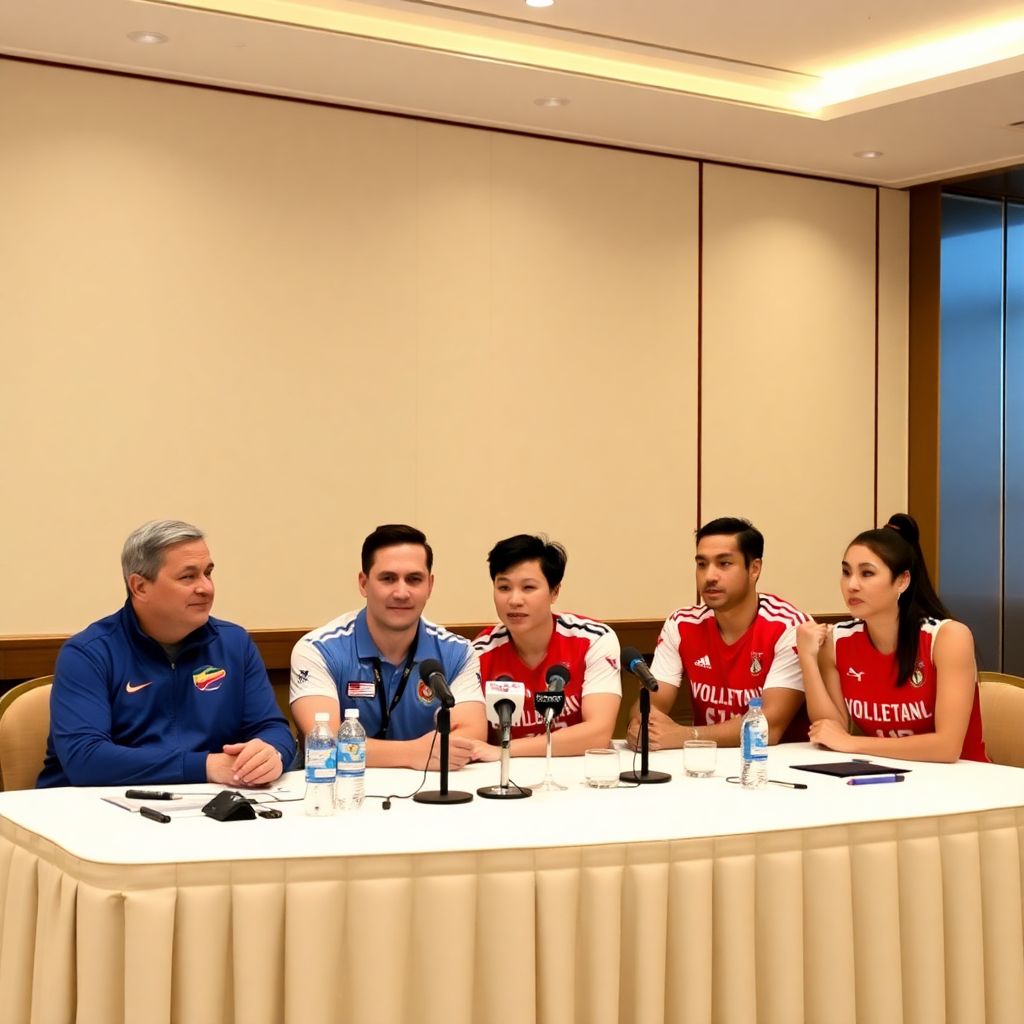
On the eve of the 2026 FIVB Women’s Volleyball Nations League (VNL) final phase, the leading figures of world volleyball met with the media at a press conference held at the Andaz Hotel in Macau, China. Head coaches and players of the qualified national teams outlined their expectations, emphasizing how balanced and unpredictable this year’s knockout stage promises to be.
Türkiye women’s national team head coach Daniele Santarelli underlined that the gap between the top teams has almost disappeared and that fans should be ready for a fiercely contested quarterfinal round. According to him, the level of competition has risen to the point where every detail can decide a match.
Santarelli stated that the finals would turn into a real volleyball festival, stressing that all eight teams fully deserve to be in Macau: he expressed his hope that each side would deliver its absolute best. In his view, what awaits spectators is not just a series of matches, but a showcase of the highest level of women’s volleyball, with intensity from the first serve of the quarterfinals to the last point of the tournament.
Looking specifically at Türkiye’s clash with Canada, Santarelli described it as “a different kind of quarterfinal” for his team. He congratulated the Canadian program, its staff and players for reaching this stage, pointing out that their progress is no coincidence but the result of systematic work and steady growth. For Santarelli, this matchup carries additional meaning because of his long-standing rivalry with Canadian head coach Giovanni Guidetti.
The Italian coach noted that over the past decade he has faced Guidetti countless times in various competitions and club environments. He described these encounters as consistently intense but respectful, always played in a strong competitive atmosphere. Santarelli stressed that he is happy to be part of this stage once again and that Türkiye’s main goal is to bring its peak volleyball to the court when it matters most.
On the other side of the net, Canada head coach Giovanni Guidetti highlighted what a historic moment this is for his team. He reminded reporters that this is Canada’s first appearance in the VNL finals stage, and that simply qualifying is already a source of tremendous pride. Guidetti underlined how special it is for his players to share the stage with the world’s elite national teams.
Guidetti explained that Canada approaches the tournament with a dual mindset: enjoyment and learning. The team wants to relish every match, but at the same time use each game as an opportunity to gain experience and accelerate its development. He emphasized that their ambition is not just to participate, but to compete at the highest possible level, pushing stronger teams to the limit and proving that Canada is no longer an outsider in women’s volleyball.
Japan’s national team, led by Turkish head coach Ferhat Akbaş, is also entering the finals with great motivation. Akbaş said it is an honor for Japan to be among the last eight and that the squad sees this stage as the natural continuation of a difficult yet rewarding journey through the preliminary rounds. For him, the VNL finals are both an exam and a showcase of the progress the team has made.
Japan will face Brazil in the quarterfinals, a matchup Akbaş views as a constant learning opportunity. He described Brazil as a “fantastic opponent” that has taught Japan a great deal over recent seasons. Every time Japan steps on court against the South American powerhouse, Akbaş feels his players emerge better and more mature. He added that the road to the finals has been demanding but enjoyable, and now the team wants to unite and deliver an outstanding performance in front of fans around the world.
Italy head coach Julio Velasco adopted a pragmatic tone when evaluating his team’s situation. He stressed that in the final phase every match is difficult, and that it is pointless to think too far ahead. Italy’s staff and players are focusing exclusively on their opening quarterfinal, preferring to talk about a potential semifinal or final only if and when they get there.
Velasco said his squad is in good condition physically and mentally. During the earlier stages of the competition, Italy rotated heavily, using different lineups across the first three matches to distribute minutes and test options. Now, as the finals begin, all key players are available and included in the roster. Velasco shared his satisfaction with having a complete group at his disposal and stated that Italy feels both happy and fully prepared for the challenges to come.
The Netherlands arrive in Macau under the guidance of Felix Koslowski, who emphasized the significance of this second consecutive trip to the VNL final phase. For the Dutch team, simply returning to this stage is evidence of continuity and progress. Koslowski underlined that the path to qualification was far from easy, requiring resilience in tight matches and constant improvement throughout the season.
In the quarterfinals, the Netherlands will face a team that Koslowski described as “perhaps the best in the world over the last two to two and a half years.” He acknowledged that this duel represents a huge test for his relatively young group. At the same time, he views it as a precious learning opportunity. The Dutch coach said that Italy’s trajectory and stability offer a model from which a rising team like his can learn a great deal. Despite the challenge, the Netherlands intend to play fearlessly, aiming to produce their highest possible level of volleyball.
The press conference concluded with a group photo featuring the coaches and selected players, symbolizing both rivalry and mutual respect among the world’s strongest volleyball nations. While each team has its own goals, styles and stories, the shared message was clear: the margins between victory and defeat have become razor-thin, and no quarterfinal is a foregone conclusion.
A Tournament Defined by Balance and Fine Margins
One of the main themes that emerged from the coaches’ remarks is the increasing parity in top-level women’s volleyball. Santarelli pointed out that the traditional hierarchy has been reshaped: on any given day, several teams can beat each other. This growing balance makes preparation more complex but also raises the entertainment value for spectators.
In previous eras, a small number of national teams clearly dominated major tournaments. Now, the evolution of training methods, sports science and tactical analysis has allowed more countries to close the gap. Guidetti’s Canada is a prime example: once considered a distant outsider, they now arrive at the VNL finals with realistic ambitions of competing toe‑to‑toe with established powers.
Tactical Chess: What to Expect on the Court
Behind the scenes, the quarterfinals promise to be a tactical chess game among some of the most experienced minds in volleyball. Velasco is renowned for his structured systems and emphasis on discipline in both side‑out and transition. Santarelli has built Türkiye around aggressive serving, a powerful offense and emotional momentum. Guidetti, known for his meticulous scouting, is likely to present highly specific game plans tailored to neutralize opponents’ strengths.
Akbaş, with his blend of European and Asian volleyball philosophies, has helped Japan combine fast, technically refined play with improved physicality. Koslowski, in turn, is working to mold the Netherlands into a modern team that can balance high-tempo offense with stable reception and solid block-defense systems. These contrasting approaches should produce stylistically diverse and tactically rich quarterfinals.
Psychological Pressure and Experience
Another decisive factor will be psychology. For Italy and Türkiye, playing under the label of favorites implies a different kind of pressure: they are expected not just to compete, but to win. Any slow start or set lost to an underdog can quickly turn into a mental burden. Coaches like Santarelli and Velasco must therefore manage emotions as carefully as lineups and rotations.
For Canada and the Netherlands, the situation is almost the opposite. As relative newcomers to the latter stages of such a tournament, they can channel the “nothing to lose” mentality. Guidetti’s remarks about enjoyment and learning underscore this approach: if his team stays relaxed and focused, they could turn that freedom into a dangerous weapon against more established rivals.
Japan sits somewhere in between. Under Akbaş, the team has grown used to facing superpowers like Brazil, Italy and Türkiye on a regular basis. That familiarity reduces the intimidation factor, but the desire to finally turn close matches into statement wins brings its own psychological weight. For Japan, the challenge is to transform respect into self-belief.
Physical Demands and the Long VNL Road
The VNL calendar is demanding: long travel, different time zones, and multiple games per week. By the time teams arrive at the finals, fatigue and minor injuries are almost inevitable. Velasco’s satisfaction with having all players available is not just a luxury; it could be a key advantage in a compressed knockout schedule where recovery time is limited.
Rotations and roster depth will be crucial. Coaches may need to make bold choices, resting key players for stretches or trusting bench options in high-pressure moments. Teams that managed their squads well during the preliminary phase are now better positioned to handle the intensity of back-to-back elimination matches.
A Showcase for the Global Growth of Women’s Volleyball
Beyond the results, this VNL final stage reflects the broader growth of women’s volleyball worldwide. The presence of programs like Canada and the Netherlands alongside traditional powers such as Brazil, Italy and Türkiye highlights how the sport’s competitive base is expanding. Investments in youth development, professional leagues and coaching education are bearing fruit.
For younger players and fans watching around the globe, the quarterfinals in Macau offer more than just entertainment: they provide role models and tactical blueprints. Seeing different styles-from Japan’s fast, disciplined play to Türkiye’s powerful, emotional volleyball-helps shape the next generation’s understanding of the game.
What Fans Can Look Forward To
As Santarelli hinted, the quarterfinals promise to be “very beautiful” not just in a poetic sense, but in terms of pure volleyball quality. Expect intense rallies, aggressive serving runs, long defensive exchanges and frequent momentum swings. Each coach has made clear that their team intends to leave everything on the court.
From the emotional storyline of Santarelli vs. Guidetti, to Japan once again trying to crack Brazil’s code, to a young Dutch squad testing itself against one of the world’s most consistent teams, the narratives practically write themselves. Yet all coaches insist that talk, predictions and reputations will mean little once the first whistle blows.
The Road Beyond the Quarterfinals
While everyone is publicly focused on the quarterfinals, the broader stakes are obvious. In addition to the VNL trophy itself, performances in Macau will influence world rankings, seedings for future tournaments and the internal confidence of each program ahead of upcoming continental championships and global events.
For teams like Italy and Türkiye, a deep run is almost a requirement to confirm their status among the elite. For Japan, Canada and the Netherlands, a semifinal or even a tightly contested quarterfinal could be another important brick in long-term projects aimed at consolidating their place on the world stage.
As the coaches and players leave the press room and turn their attention back to training courts and video sessions, one thing is certain: the 2026 VNL Women’s finals have all the ingredients for a thrilling spectacle. With quality evenly spread and motivations running high, “a great quarterfinal” is not just a prediction-it is an expectation shared by everyone involved.