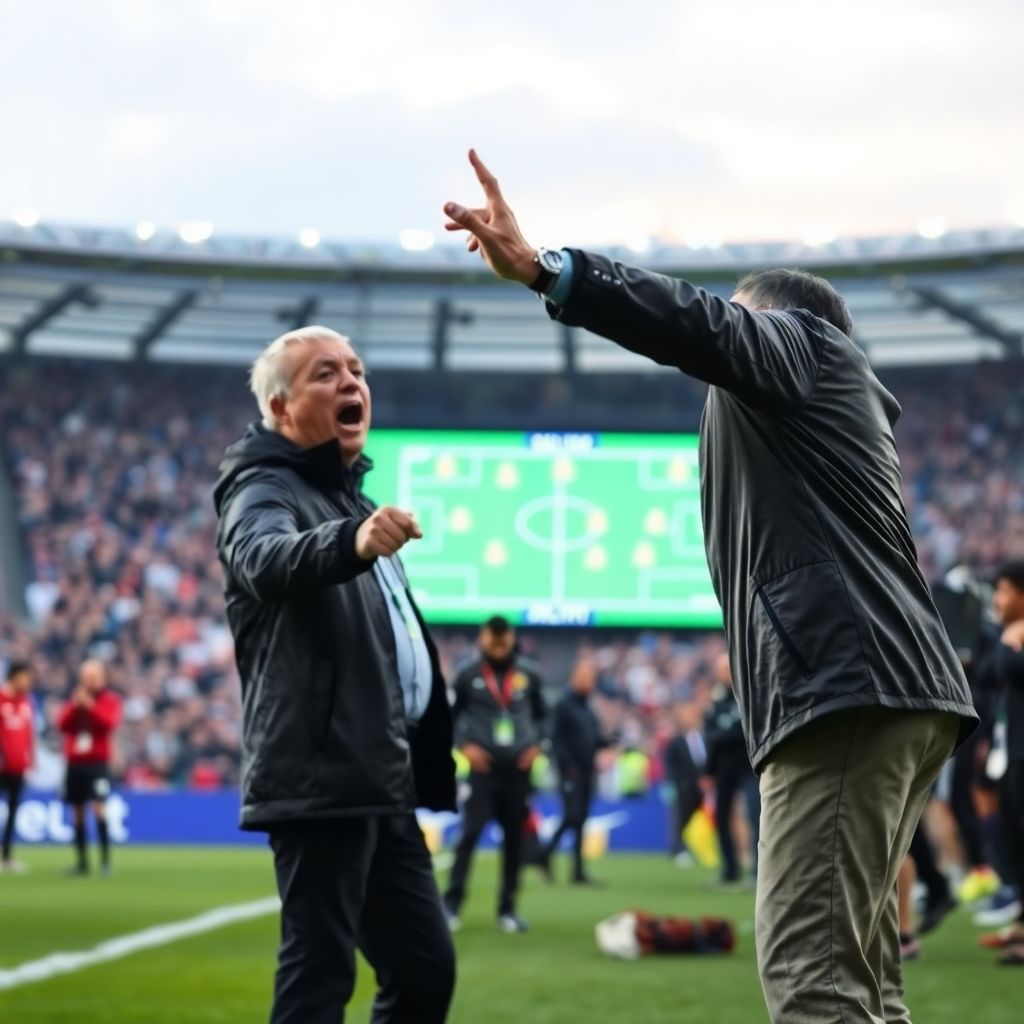
Turkish coaches in European leagues are a growing group of tactically flexible, emotionally intense managers who blend modern analytics with man‑management. For clubs, they tend to be relatively easy to integrate in ambitious, underdog or transitional projects, but their high‑pressure communication style and expectation‑heavy methods can create risk if board, squad and fans are not aligned.
Why Turkish coaches are becoming prominent in European leagues
- A generation formed under both local passion and European tactical schooling now fits modern, high‑intensity league demands.
- UEFA licensing, agent networks and diaspora links make moves abroad more accessible and lower perceived hiring risk.
- They are comfortable in unstable, result‑driven environments, attractive for clubs in relegation or rebuild scenarios.
- Turkish coaches often over‑index in motivation and game management, adding a clear identity to mid‑budget squads.
- The tactical mix of pressing, quick transitions and set‑piece focus is relatively quick to implement with existing rosters.
- Visible success cases have normalized the idea of turkish football manager jobs in europe for boards and supporters.
Evolution of Turkish coaching: from domestic roots to continental stage
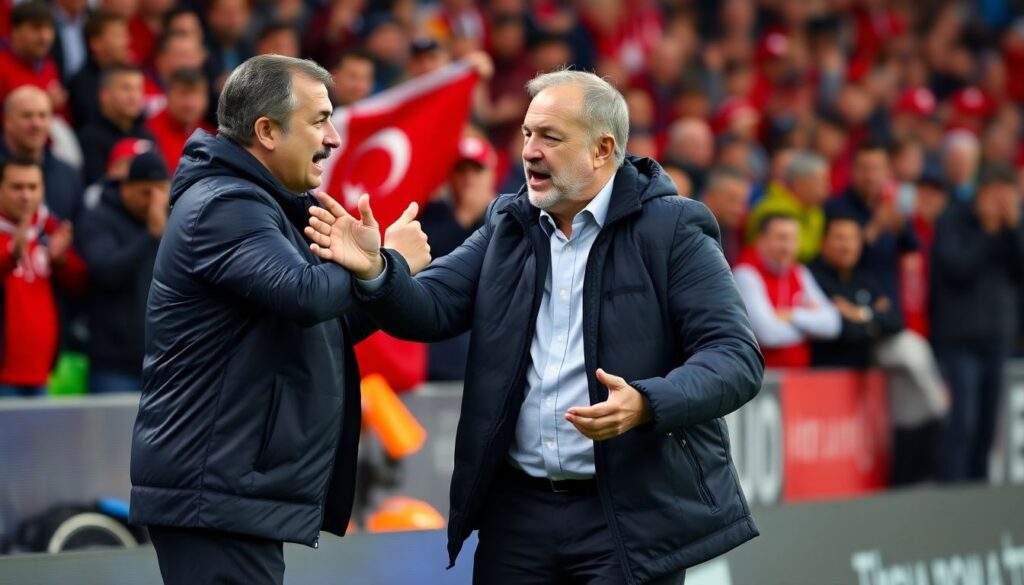
The rise of Turkish coaches in European leagues started with domestically successful managers whose teams mixed emotional intensity with strong home‑field advantage. For years, their reputations remained “local specialists”, suited mainly to Süper Lig and regional competitions.
As tactical trends shifted toward pressing, compact blocks and fast transitions, many Turkish coaches modernized through foreign assistants, international study visits and UEFA education. They integrated video analysis, set‑piece labs and conditioning models from Europe without abandoning the emotional core of Turkish football culture.
This evolution created a profile that foreign clubs find intriguing: coaches used to chaotic boards, hot atmospheres and constant media pressure. Compared with some traditionally conservative domestic managers in other countries, they appear more willing to take over crisis projects and accept short contracts, which changes the ease and risk calculation for sporting directors.
Today, when people search for a list of turkish coaches managing european clubs, they usually find a mix of two generations: pioneers who opened doors with early moves abroad, and a younger group fluent in languages, analytics and social media, already framed as “European” rather than purely “Turkish” coaches.
Certification, pathways and networks that open doors to Europe
Formal education and informal networks both matter for the new wave of turkish football coaches in europe. The main mechanisms work together and either lower or increase hiring risk for clubs.
-
UEFA licensing as a shared language
Modern Turkish coaches typically complete turkish football coaching courses uefa license programs, gaining UEFA A and Pro licenses that align them with European standards. For foreign clubs, this instantly reduces regulatory risk and provides a familiar framework for training methodology and match preparation. -
Assistant and analyst roles abroad
Many future head coaches first work as assistants, fitness coaches or video analysts in Europe. This path lets boards test their adaptation and communication with low cost and limited downside, before trusting them with the main job. -
Agent networks and diaspora links
Agents who specialize in the region present Turkish managers as high‑impact, mid‑cost options compared with top Western names. Diaspora club directors and owners, especially in Germany, the Netherlands and Scandinavia, further lower the cultural barrier and champion these candidates internally. -
Success ladders via smaller leagues
Instead of moving directly to top five leagues, many Turkish managers prove themselves in Eastern, Central or Nordic European competitions. This creates a visible track record for the next employer, lowering perceived risk step by step. -
Reputation loops from European competitions
Strong performances with Turkish clubs in UEFA tournaments showcase tactical quality and in‑game management. When a coach repeatedly overperforms budget in Europe, foreign sporting directors start treating them as realistic candidates rather than “exotics”. -
Media visibility and data platforms
Today, video, tracking data and public analysis highlight patterns in their teams. Wide visibility makes due diligence easier; sporting directors can quickly benchmark a Turkish coach’s style and risk profile against other available options using shared metrics and clips.
Tactical trademarks and coaching philosophies common among Turkish managers
Even among the best turkish managers in european leagues, there is variety, but several repeatable tactical patterns appear, which affect ease of implementation and risk when they enter a new dressing room.
-
High‑energy pressing and emotional momentum
Many Turkish coaches favour aggressive pressing phases, especially at home or in key matches. Implementation is relatively quick if fitness levels are decent, but the risk is structural fatigue and defensive exposure if the squad lacks depth or buy‑in. -
Compact defensive blocks with fast counters
For underdog clubs, Turkish managers often choose a compact 4‑1‑4‑1 or 4‑2‑3‑1, with rapid transitions through wide players. This style is convenient to introduce mid‑season and fits limited technical squads, yet it can limit attacking variety and make the team predictable against deep‑defending opponents. -
Set‑piece specialization
Frequent use of detailed routines in corners and free kicks is a hallmark. This offers high return for modest training time and low risk, making it one of the easiest elements for any club to adopt quickly under a new Turkish coach. -
Strong central playmaker or target focus
Many systems are built around a key “10” or a physical striker as reference point. Implementation is straightforward if the squad already has the right profile; risk rises when the roster lacks such a player and recruitment cannot adjust in time. -
Flexible structures, clear emotional identity
Formations may change from 4‑2‑3‑1 to 3‑4‑3 or 4‑4‑2 diamond within a season, but the emotional cues (aggression, unity, “us against the world”) stay constant. This flexibility helps adaptation to league demands, though it may confuse players used to strict, system‑based football.
| Aspect | Typical Turkish coach in Europe | Typical Western European mainstream coach |
|---|---|---|
| Ease of short‑term implementation | High: clear, emotionally charged game plans, quick impact via pressing and set‑pieces. | Medium: often more structural rebuilds, positional play needing more time and signings. |
| Medium‑term tactical stability | Variable: frequent tweaks; can feel reactive if results fluctuate. | Usually more stable frameworks, clearer long‑term automatisms. |
| Man‑management approach | Direct, intense, relationship‑driven; high motivation, higher conflict risk. | More process‑ and role‑driven; sometimes less emotionally volatile. |
| Public communication | Expressive, narrative‑oriented; quickly bonds with fans, but pressure can spike. | Often more controlled and corporate; fewer public mood swings. |
Success stories and turning points: illustrative club and coach case studies
To understand both upside and risk when hiring from the growing pool of turkish football manager jobs in europe, it helps to look at patterns from notable appointments. While specific careers differ, successes often share clear communication, aligned expectations and realistic timelines; failures typically expose cultural or structural mismatches.
Positive impact patterns
- Clubs in relegation battles that adopt a compact, aggressive style improve defensive solidity and regain fan energy under a Turkish coach.
- Ambitious mid‑table sides use his motivational skills to build strong home records and push for European qualification spots.
- Young squads benefit from clear hierarchy and emotional leadership, translating into improved intensity and concentration in big matches.
- Boards that explicitly commit to the coach’s identity (pressing, direct attacks, emotional framing) see faster, more coherent implementation.
Limitations and failure modes
- Technical, slow‑paced teams struggle to adapt to high‑intensity demands, leading to injuries and confusion in the early months.
- Clubs expecting instant results but unwilling to back the coach in recruitment create internal tension and short cycles.
- Media misinterpret emotional press conferences, escalating minor issues into crises that destabilise the project.
- Language gaps limit nuanced feedback, reducing the efficiency of training and video sessions, especially in highly tactical leagues.
Structural drivers: clubs, agents, federations and talent pipelines
Beyond individual quality, structural forces push more Turkish managers onto European benches. Understanding these helps clubs judge whether hiring from this market is an opportunistic move or part of a broader, sustainable trend.
-
Assuming all Turkish coaches are “firefighters”
Many are indeed crisis‑capable, but the myth that they are only short‑term motivators ignores those who build multi‑year projects with youth integration and modern analytics. Reducing them to saviour roles can waste their long‑term value. -
Overestimating agent hype
Strong agent networks create visibility but can also inflate expectations. Some boards hire on reputation and charisma rather than fit, then blame “Turkish temperament” when the mismatch shows. The error is structural: weak internal evaluation, not nationality. -
Undervaluing federation and club‑academy work
It is a myth that Turkish coaches succeed abroad only through individual genius. Many were shaped by structured academy programs and federation courses. Ignoring this context leads to simplistic comparisons with other markets and flawed risk assessments. -
Expecting identical methods across all Turkish coaches
Labeling them as one style (“emotional, attacking”) hides real tactical diversity. Some are possession‑oriented, others reactive; some data‑heavy, others more intuitive. Treating them as a homogenous group raises implementation risk because the actual fit is never properly analysed. -
Confusing market inefficiency with low quality
Salaries and fame levels are often lower than for similar‑level Western coaches. This does not signal lesser competence; it often reflects league reputation and language factors. Clubs that see this as inefficiency, not weakness, can gain competitive advantage.
Obstacles and adaptation: language, culture, expectations and performance metrics
Hiring from the pool of best turkish managers in european leagues or from emerging names offers high upside, but adaptation risks are real. How quickly a project stabilises depends on communication, shared metrics and how the coach’s intensity is framed inside the club culture.
Consider a mini‑case scenario. A mid‑table Central European club appoints a Turkish coach mid‑season:
- Week 1-2: He simplifies the game model (compact 4‑4‑2, clear pressing triggers), and uses interpreters plus bilingual staff to communicate principles. Short‑term implementation is straightforward.
- Week 3-6: Training intensity increases; a few muscle issues appear. Without prepared sports science integration, the risk of overload grows and some senior players question methods.
- Month 2-3: Results improve, but media misinterpret emotional celebrations as arrogance. The board must reframe the narrative, or external pressure may spike at the first losing streak.
- Month 3-6: If the club and coach align on performance metrics (not only points, but pressing efficiency, xG balance, squad development), the project stabilises. If not, expectations diverge and the relationship deteriorates despite underlying progress.
In practice, the difference between successful and failed appointments is rarely tactical knowledge. It is almost always preparation around language support, cultural onboarding and transparent KPIs.
Quick checklist for clubs considering a Turkish coach
- Have we mapped his tactical profile against our squad’s physical and technical strengths, not just our league position?
- Do we have a clear plan for language support, staff integration and media communication from day one?
- Are board, dressing room leaders and fans aligned on the emotional, high‑intensity style he is likely to bring?
- Have we agreed measurable, shared performance metrics beyond short‑term results to evaluate his work fairly?
- Is this hire part of a broader sporting vision, or a reactive move based only on recent headlines and agent lobbying?
Practical answers on recruiting, evaluating and integrating Turkish coaches
How should a club start scouting Turkish coaches for a specific project?
Begin with your game model and budget, then search for coaches whose teams play a compatible style in leagues of similar or slightly lower level. Use video, data platforms and references from players who have worked under them to check fit and adaptability.
What are the main red flags when interviewing a Turkish coach for a European role?

Watch for vague descriptions of training methodology, lack of clarity about staff roles, and dismissive attitudes toward language learning or analytics. Over‑promising on instant transformations without acknowledging constraints is another warning sign.
How much does language proficiency matter for a Turkish coach abroad?
Basic working knowledge of English or the local language is extremely helpful, especially for training detail and media pressure. With strong bilingual staff, a coach can bridge gaps initially, but a total refusal to progress linguistically usually increases long‑term risk.
Are Turkish coaches better suited to short‑term “firefighting” or long‑term projects?
Many are excellent in crises because they change mentality and intensity quickly. However, some also build strong academy links and multi‑year structures. The key is to check their history: did they improve youth pathways, squad value and tactical sophistication over time?
How can a club reduce adaptation risk in the first 90 days?
Provide a clear internal liaison, agree on a simple initial game model, and pre‑define communication routines with staff, players and media. Align medical and fitness departments with the coach’s intensity to prevent overload and avoid conflicting messages.
What performance metrics work best when assessing a Turkish coach?
Combine results with process indicators such as pressing intensity, shot quality balance, set‑piece output and player development minutes. This mix reflects their typical strengths and offers a fairer evaluation than points alone, especially in difficult contexts.
Do Turkish coaches usually bring their own backroom staff?
Most prefer a trusted assistant and at least one fitness or analyst specialist. Clubs can negotiate a hybrid model, combining his core staff with existing personnel to keep continuity and ease cultural integration on both sides.