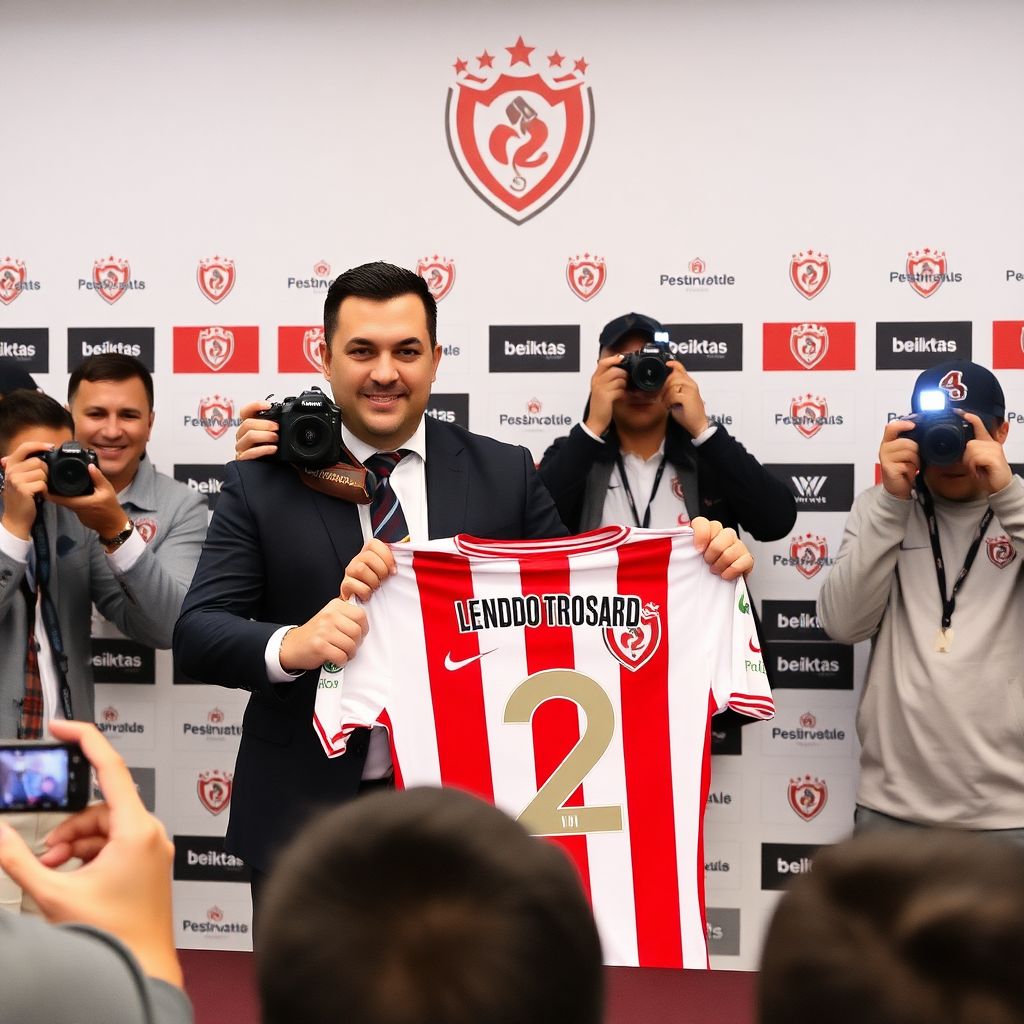
Serdal Adalı announces Trossard breakthrough: lower salary, advanced talks with Arsenal
Beşiktaş president Serdal Adalı has confirmed that the club is on the verge of signing Arsenal winger Leandro Trossard and underlined that the Belgian star will arrive on a lower salary than he currently earns in England.
Speaking to reporters during the team’s pre-season camp in Slovakia, Adalı shared key details of the negotiations with both Trossard and Arsenal, while also addressing the financial strategy behind the move and calling for unity among Beşiktaş supporters.
—
Arsenal insisting on sell‑on clause for 31‑year‑old Trossard
Adalı revealed that Arsenal are pushing to include a sell-on clause in the deal, even though Trossard is already 31:
> “For 31-year-old Trossard, Arsenal still wants to insert a share from any future sale. We want to bring in a player of this profile. Let me be clear: this will not be Trossard’s last contract. That needs to be understood.”
The president stressed that focusing only on the Belgian winger’s age is misleading. In his view, Trossard still has several high-level seasons ahead of him and represents both a sporting and financial asset rather than a short-term gamble.
Adalı also dismissed transfer rumors linking the club with stars of Mohamed Salah’s caliber, explaining that names of that level often appear only because Beşiktaş are actively looking to strengthen:
> “Everyone is talking about Trossard now because of the Dikilitaş project and the resources we are creating. It’s not right, but people throw around Salah rumors as well. This happens simply because we are generating funds and moving in the transfer market.”
—
Last season’s failed move: huge offers turned down
The Beşiktaş chief underlined that the club’s interest in Trossard is not new. They already tried to sign him in the previous season but were blocked by Arsenal’s stance:
> “Last year I offered 25 million euros for Trossard. I also made an 8 million euro offer, but it didn’t happen, they didn’t let him go. This time we are getting him for a lower salary.”
Adalı highlighted that, compared with the previous attempt, Beşiktaş are now in a stronger negotiating position. The club’s financial planning and the structure of the current offer allow them to bring the Belgian to Istanbul on more favorable terms, despite the competition on the market for experienced attacking players.
For Beşiktaş, landing a Premier League winger with Champions League and international experience is seen as a key step in raising the squad’s overall quality and international profile, without breaking the wage structure.
—
Ouattara signed at Italiano’s request
While Trossard remains the headline name, Adalı also pointed to the arrival of French left-back Kassoum Ouattara as proof that the club is acting in line with head coach Vincenzo Italiano’s plans:
> “We were evaluating different options for left-back. Ouattara was someone the coach really wanted, so we went and signed him.”
By stressing the coach’s influence in transfers, Adalı sent a clear message: the club does not want star signings just for show, but players who fit the tactical system and can offer long-term value on the pitch. Ouattara is viewed internally as an investment in both sporting performance and potential resale value.
—
Call for unity: “Only one Beşiktaş, one tribune”
Beyond transfers, Adalı devoted a large part of his conversation to the club’s supporters, issuing a direct appeal for unity in the stands:
> “The only thing I want is unity among the supporters. I don’t want the tribunes to be fragmented. There are many groups, but only a few of them write things on social media. This season we want complete unity in the stadium. There are three to five people whose intentions are obvious.”
He reminded everyone that the fan base is the heart of the club:
> “Our supporters are the heart of this community, its most important part. When they are not satisfied, they criticize the players, the coach, and us – and that’s their right.”
As someone who came from the stands himself, Adalı framed his remarks as a heartfelt plea rather than a reprimand:
> “I am someone who came from those tribunes, an older brother and now their president. I simply expressed my feelings and my assessment of last season. This year we are even increasing stadium capacity so our fans can support a stronger team.”
—
Capacity increase and atmosphere: making Vodafone Park a fortress again
Adalı explained that the club is working on capacity expansion in the stadium to make sure more fans can attend matches and recreate the intimidating atmosphere that once made Beşiktaş’s home ground one of the toughest places to play:
> “We are a family. No one can come between us. Beşiktaş tribunes have the strength to do much better than before, and they will show it this season. Our team is getting stronger on top of last year’s transfers. I want our supporters to again be the biggest driving force behind this team, just like in the past, and I am sure they will be.”
By linking the strengthening of the squad with the improvement of the stadium environment, Adalı signaled that the club’s project is not just about signings and balance sheets, but also about restoring identity and collective energy.
—
Audit report controversy: “We cut 3-4 million euros in interest”
Adalı also responded to criticisms arising from a recent audit report, which claimed that prepayments from the Dikilitaş real estate project were used to cover loans granted by board members. The president argued that the report was not properly worded and gave a distorted picture:
> “The audit committee should have explained this correctly in the report. We paid bank debts and saved 3-4 million euros in interest. An early payment allowed us to get a discount. This needed to be explained properly. There is no such thing as us keeping money inside the club for ourselves. On the contrary, money is constantly flowing from and back to the accounts of the board members.”
For Adalı, using project income to pay down high-interest bank loans is not a misuse of funds but a strategic move to protect the club from escalating financial risk. He insisted that transparency exists, but that technical details must be communicated clearly to avoid misunderstandings.
—
From 128 to 53 million euros: restructuring the bank debt
Detailing the financial turnaround, Adalı laid out concrete numbers regarding the club’s bank liabilities:
> “We took over the bank debt at 128 million euros; right now it is 53 million euros. Whatever funds we found, we directed them there, and the board members also contributed for this purpose. From Dikilitaş alone, 1.5 billion lira came in, and in total 3 billion lira has been paid into the banks.”
These figures underline a central message: while Beşiktaş are active in the transfer market, a major part of their strategy has been focused on cutting interest expenses and reducing the most burdensome debts, rather than simply accumulating new ones.
—
Real estate projects to close the gap with rivals
Adalı openly acknowledged that rival clubs widened the financial and sporting gap in recent years largely by leveraging real estate projects. Beşiktaş, he stressed, has decided to follow a similar path – not as an option, but as a necessity:
> “We have already emphasized how important real estate projects are. Our rivals opened the gap in this way. We said, ‘We have to do this too.’ Should we not pay the debts then? Should we let them wait indefinitely and only pay when money randomly comes in? Should we let the interest burden grow and grow? That is impossible.”
Using the Dikilitaş project as an example, he reminded everyone that this asset did not exist before the current administration:
> “Was there such a place as Dikilitaş? No, we created it. And we did it to pay the debts. What remains after that will be used for transfers. What we have done is already visible.”
The message to the fan base is clear: any short-term discomfort or controversy surrounding real estate projects must be seen in the context of a long-term plan to stabilize finances and build competitive squads.
—
“Our priority is to stop the interest clock”
Adalı admitted that the club’s total debt figure will inevitably rise as new players are signed, but insisted that the quality and collateral behind those debts are what truly matter:
> “Of course the debt will increase; we are signing players. We are investing. Our main objective is first to stop the interest. Once the interest-bearing debt is gone, the remaining ‘normal’ debt can be paid off.”
He sharply criticized those who compare the previous board’s borrowing with the current administration’s without looking at what was actually gained:
> “People say the former management created 100 million euros of debt, and we also created 100 million euros of debt. But there is no real countervalue for the 100 million they spent. Our players are there for everyone to see. Each one has a value, a clear equivalent. Debt will exist – but what matters is having something real in return.”
This line of reasoning aligns with the club’s broader approach: using debt as a tool for investment rather than as a symptom of mismanagement.
—
What Trossard would bring to Beşiktaş
Although Adalı did not go into tactical details, the pursuit of Trossard fits a clear sporting profile. The Belgian is a versatile winger who can also operate as a second striker or attacking midfielder, offering:
– Experience at Premier League and European competition level
– Creativity in the final third and goal-scoring contribution from wide areas
– Tactical flexibility, allowing the coach to switch systems during matches
For Beşiktaş, adding such a player on lower wages than his current deal in England represents a rare opportunity: a high-impact signing without completely distorting the wage structure. Combined with the arrival of Ouattara and potential further reinforcements, the aim is to build a squad capable of challenging for the Süper Lig title and competing seriously in Europe.
—
Balancing ambition and responsibility
Adalı’s remarks paint a picture of a club trying to walk a fine line: investing heavily enough to satisfy supporters hungry for trophies, while simultaneously cutting interest costs and reshaping its balance sheet.
On one side of the scale stands the promised arrival of Trossard and the coach’s preferred signings like Ouattara; on the other, a meticulously structured financial plan built around:
– Reducing bank debt from 128 to 53 million euros
– Using real estate income, especially from Dikilitaş, to service loans
– Prioritizing the end of interest-bearing liabilities
– Ensuring that every new euro of debt is backed by tangible assets, primarily players with resale value
For the president, the equation is simple: a strong Beşiktaş on the pitch must be underpinned by a sustainable Beşiktaş off it.
—
The decisive role of the fans in the new era
Ultimately, Adalı tied every topic – from Trossard to Dikilitaş, from interest payments to stadium capacity – back to the supporters. In his view, transfers and financial restructuring will only reach their full impact if the stands act as a single, unified voice:
– A more powerful squad needs a more powerful tribune
– Internal conflicts among fan groups only weaken the team
– The club’s “family” identity is its biggest intangible asset
As Beşiktaş prepares to unveil new signings and launch a season built on renewed ambition, Adalı’s message is clear: the club is investing, restructuring, and taking risks – but the decisive factor will be whether the black-and-white faithful stand together behind the team from the first minute to the last.