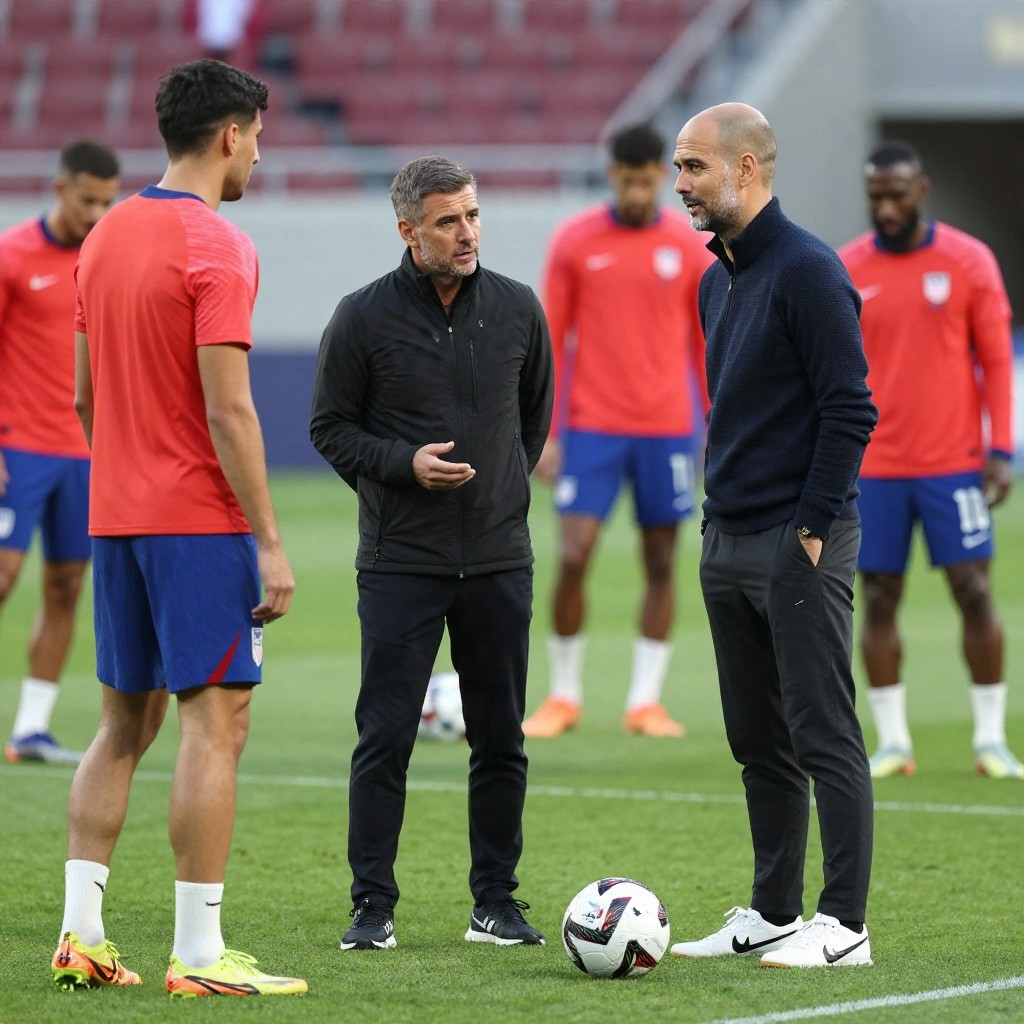
Pochettino urges Guardiola to consider the US national team job
Mauricio Pochettino believes Pep Guardiola should accept the chance to coach the United States if the national federation offers him the position. The Argentine, who has left the US national team to take charge of Manchester United, says the role would come at an especially promising moment for American soccer.
Asked what he would tell Guardiola if the Spaniard sought his advice, Pochettino gave a direct answer: “Accept it.” He argued that the federation is moving in the right direction and that a new coach would work with talented players as well as capable people behind the scenes. In his view, the squad could adapt to Guardiola’s footballing ideas.
The two coaches know each other from both their playing days and their time in management. They faced one another 22 times as Premier League managers. In September, they also met at Yankee Stadium in New York, where Guardiola had gone to watch a match. JT Batson, the US Soccer Federation’s chief executive and general secretary, was also present.
Their conversation touched on Pochettino’s return to English football. Guardiola asked whether he wanted to go back to the Premier League. Pochettino said he had been happy with the national team, but acknowledged that he missed the everyday rhythm of club management: regular training sessions, press conferences and spending time with players.
International coaching offers a different routine. Coaches gather their squads for camps and matches, then may have to wait until the next international window. In between, they watch games, travel and handle administrative work. Pochettino said those responsibilities can be rewarding, but they are not the same as being with a team day after day.
When Manchester United presented an opportunity, he was ready to return to club football. “I want to prove myself again,” he said, explaining why he accepted the move.
Pochettino also noted that the national-team role had benefits for his personal life. With one grandchild and another on the way, the less intensive schedule gave him more opportunities to spend time with his family.
A growing reputation for the US job
Pochettino believes the standing of the United States coaching position has improved. He said that, particularly after the World Cup, European football’s view of the role had changed. A job once seen as less attractive to coaches based in Europe is now, in his assessment, a more prestigious prospect.
He suggested that interest from clubs such as Manchester United, Real Madrid or Barcelona in the US national-team coach could help change perceptions further. If leading clubs take notice of the person in charge of the American side, other high-profile managers may begin to see the position as a serious career opportunity. Pochettino mentioned Antonio Conte as one example of a coach who might consider it.
His own career path, he added, illustrates how dramatically opinions can shift: he went from Chelsea to the United States national team and then returned to the Premier League with Manchester United. Such moves can make an international role appear less like a detour and more like a valuable stage in a manager’s career.
For Guardiola, the appeal would depend on more than prestige. A national-team coach has limited time with players and must build a system around short training camps, while a club manager can work on tactical details throughout the season. Pochettino’s argument is that the US job offers a compelling project: a developing football environment, talented players and the opportunity to shape a team over time.
The contrast between club and international management is central to his recommendation. The national-team post provides a broader perspective and more time away from the daily demands of a club, but it also requires patience and careful planning. Coaches must assess players across the season, identify combinations that work and make the most of brief periods together.
Pochettino’s own experience appears to have shaped his view. He valued the family time and distinct challenges of working internationally, yet still missed the close, continuous involvement that comes with coaching a club. His decision to return to Manchester United reflects that personal preference, while his advice to Guardiola recognises that another manager may find the US opportunity attractive for different reasons.
Ultimately, Pochettino sees the role as one with growing stature and potential. If Guardiola were offered the job, he believes the timing, the players and the direction of the federation would make it an opportunity worth taking.