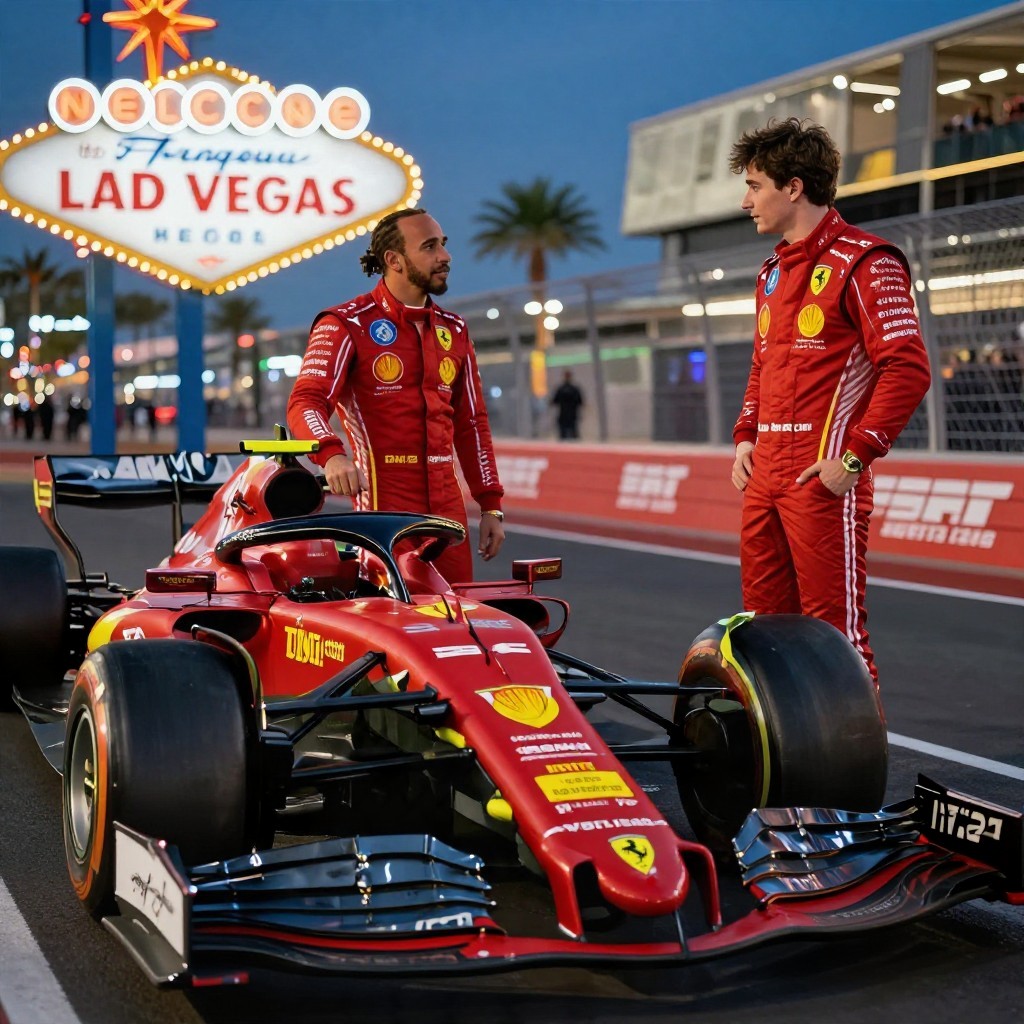
Hamilton: “Charles is a great driver”
Lewis Hamilton says he has no concerns about racing Charles Leclerc and does not believe their on-track rivalry will become a problem for Ferrari. Speaking ahead of the Las Vegas Grand Prix, the British driver also rejected the suggestion that recent disagreements over strategy had damaged his relationship with the team.
Hamilton’s decisions during two of Ferrari’s last four races had attracted attention. At the Singapore Grand Prix, he chose not to follow a call to pit during a virtual safety car period and instead continued on a one-stop strategy. The move initially kept him in contention, but his tyres deteriorated late in the race. As grip faded, he dropped from third to sixth.
Afterwards, Hamilton accepted responsibility for the choice, apologised to the team and described the outcome as a painful lesson. The episode highlighted the risks of overruling a strategy call: a driver may gain track position in the short term, but can be left vulnerable if tyre wear becomes decisive.
A similar disagreement arose in Brazil. Ferrari called Hamilton in at short notice to switch to intermediate tyres, but he declined. As the rain intensified, he spun while trying to pass Liam Lawson and finished ninth. Hamilton later said he had not received the information he needed early enough to make the call with confidence.
Asked whether these incidents had created a lack of trust between him and Ferrari’s engineers, Hamilton said they had not. He described the issue as one of communication rather than confidence in the team.
“No, absolutely not. It’s not about trust,” he said. “We are always trying to improve our communication. I think we’ve reached a much better place this year, and our race engineer, Carlos Santi, is doing a great job.”
Hamilton said the timing of the information in Brazil had been a particular concern. He added that he and the team would continue working to make sure the messages he needs arrive sooner, while stressing that everyone is pulling in the same direction.
“There is complete unity between us,” he said. “Everyone is making an effort to move forward together.”
The comments came after another high-profile moment involving Leclerc at the Mexico City Grand Prix. Leclerc attempted to pass Hamilton, and the two Ferrari drivers lost time in the exchange. Hamilton criticised his team-mate after the race, while team principal Fred Vasseur said he was unhappy with the drivers’ conduct and described the incident as a lack of respect for the team.
Hamilton and Leclerc subsequently spoke about what had happened during the Brazilian Grand Prix weekend. Ahead of the next race in Las Vegas, Hamilton said he believed they could compete fairly without letting the Mexico incident become a recurring source of tension.
“I think Charles is a great driver,” Hamilton said. “We had a very detailed conversation. Once we put our visors down, we understand each other, our limits and the goal of getting the best possible result for the team.”
He added that he had no anxiety about competing against Leclerc and did not expect their relationship to cause difficulties in the future. His remarks suggest that the drivers’ discussion helped clarify how they intend to approach close battles on track, although the real test will come when they are racing wheel to wheel again.
For Ferrari, clear communication matters especially when conditions change quickly. Decisions about pit stops, tyre choice and changing weather can determine whether a driver gains an advantage or loses valuable time. When a call comes late, the driver must weigh the team’s information against what they can feel from the cockpit, often with only seconds to decide.
The Singapore and Brazil incidents also show why strategy disagreements are not automatically evidence of a breakdown in trust. A driver may question a call because of what is happening on track, while the team is working from a wider set of data. The challenge is to ensure that both sides can exchange the relevant information quickly and understand the reasoning behind a decision.
Hamilton’s focus, then, is on improving that process rather than assigning blame. He has acknowledged the consequences of his choices and says he remains confident in Ferrari’s staff. His comments also indicate that he and Leclerc want to keep their competition within agreed boundaries, with the team’s result as a shared priority.
As Ferrari heads into the Las Vegas weekend, both issues remain important: the drivers need to race each other hard without compromising the team, and the engineers need to deliver timely, precise guidance when circumstances shift. Hamilton’s public message is that neither challenge has undermined his confidence in Ferrari or his willingness to fight alongside Leclerc.