Historical background: how two football cultures grew apart
When you look at any Premier League vs Super Lig comparison, you’re really looking at two different football histories that shaped the way players think and move on the pitch. English football grew out of a long tradition of direct play, physical duels and heavy pitches, then layered continental tactics and big-money globalization on top of that. The modern Premier League is the outcome of that mix: an export product built around pace, constant transition and a marketing machine that pushes clubs to play in a way that is watchable worldwide. In Turkey, professional football developed later, and the Süper Lig became an emotional focal point for cities and fan bases, with derbies turning into social events. That passion encouraged coaches to build teams where individual expression, dribbling and crowd‑pleasing moments could coexist with fairly rugged defensive play, especially in hostile away grounds.
Over the last two decades, the influx of foreign coaches and players has affected both leagues, but in distinct ways. In England, top clubs embraced positional play, complex pressing schemes and data-driven planning, while mid-table teams copied at least parts of those patterns to survive. The result is an ecosystem where even relegation candidates usually have a defined game model. In the Süper Lig, foreign influence has been more uneven: a few coaches try to implement modern structures, but turnover is high, presidents are impatient, and the league’s financial swings disrupt long-term projects. That’s why Super Lig vs Premier League playing style can feel like a contrast between a highly standardized product and a more volatile, emotionally driven competition where the context of each club and city still plays a massive role in how the game looks.
Basic principles: tempo, risk and space management
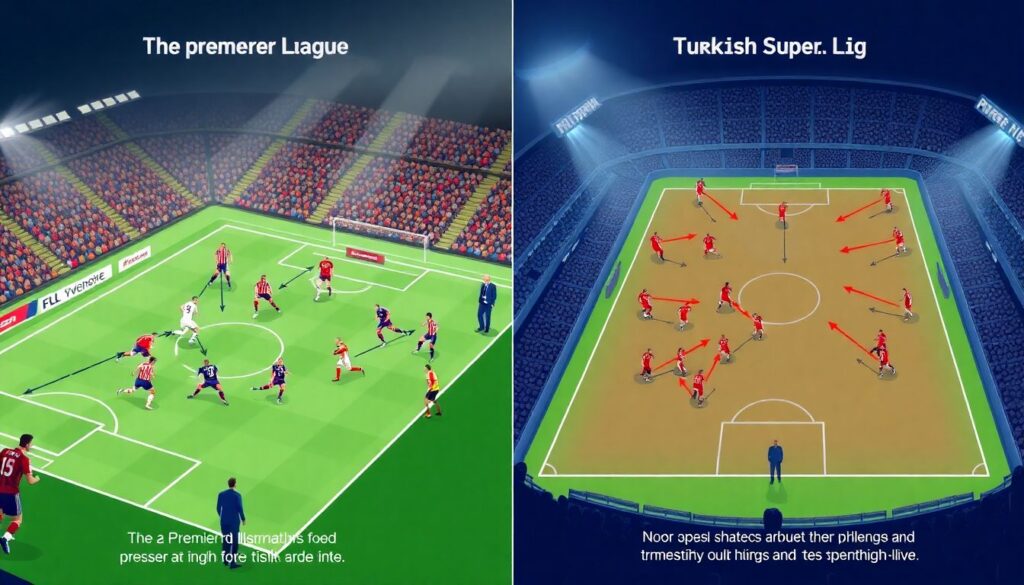
If you strip away the noise, the core difference between Premier League and Super Lig football lies in how teams manage tempo and risk. English sides, especially in the top half, are obsessed with controlling transitions. They press high, keep compact distances between lines and try to win the ball back within seconds. The tempo is not just fast in terms of running speed; it’s fast in terms of decision cycles. Players are coached to make predefined choices: where to press, where to funnel the opponent, which zones to overload. In Turkey, there is often more tolerance for chaotic phases. Teams may start with a structured plan, but matches frequently devolve into end‑to‑end exchanges, where the bravest dribbler or the most confident long‑shot taker becomes the main problem-solver.
Another key principle is how each league values territory versus control. In the Premier League, many coaches prioritize territorial dominance: push the opponent back, pin them in, and recycle possession to keep pressure constant. Even clubs that don’t play heavy possession still think about controlling space vertically and horizontally, using compact blocks or orchestrated counterattacks. In the Süper Lig, you see more extremes. Some coaches sit very deep and rely on set pieces and individual counters, while others stretch their own team too much in search of attacking numbers. That makes the Premier League vs Turkish Super Lig tactics and tempo question less about “who is faster” and more about “who accepts more structural risk.” Generally, English teams look more synchronized in how they accelerate and slow games down, whereas Turkish sides are quicker to abandon structure if the emotional temperature of the match demands it.
Implementation examples: pressing, build‑up and problem‑solving
Let’s look at pressing as a concrete example. Top Premier League teams treat pressing like a choreographed dance. Forwards curve their runs to block passing lanes, midfielders jump at exactly timed triggers, and the back line squeezes up to compress space. Even mid‑table clubs now use semi‑coordinated high or mid‑block pressing systems that are drilled on the training ground. This isn’t only about aggression; it’s about removing the opponent’s comfortable options one by one. In the Süper Lig, pressing schemes are more uneven. Some title contenders attempt modern pressing, but many sides press in bursts: a few high‑energy sprints, then a lapse, then a scramble back. Training time, squad continuity and fitness levels all play a role. It means that the same “press” can look suffocating in England and patchy in Turkey, even if the initial idea on the whiteboard is similar.
Build‑up play shows another layer of the difference between Premier League and Super Lig. English clubs increasingly construct play from the back with clear patterns: full‑backs invert, pivots drop between centre‑backs, wide players narrow into the half‑spaces. These patterns give defenders automated solutions under pressure. Turkish teams often attempt similar structures, but the execution varies more and can change from game to game, or even from half to half, depending on the coach’s fear of mistakes. When the crowd turns restless after a few risky passes around the box, some Süper Lig teams immediately revert to long balls to the striker as a safer “problem‑solving” tool. So when we talk about Super Lig vs Premier League playing style, we’re really comparing how much each environment rewards players for trying structured solutions versus improvising escapes once the game becomes uncomfortable. In England, sticking to the system under pressure is praised; in Turkey, breaking the script at the right moment can make you a hero.
Different approaches to solving tactical and game‑management problems
In high‑pressure matches, both leagues face similar problems: how to break a low block, how to protect a lead, how to handle a swing in momentum. But the preferred answers differ. In the Premier League, many coaches lean on pre‑planned mechanisms: rotations to unpin markers, rehearsed set‑piece routines, and pre‑defined substitution patterns to refresh the press or lock down a flank. The whole week’s preparation is aimed at reducing uncertainty on match day. In the Süper Lig, in‑game problem‑solving is often more reactive and shaped by emotion. A coach might respond to conceding a goal not with a subtle adjustment to the midfield box, but by throwing on another forward to ride the wave of crowd energy. Sometimes it works brilliantly, sometimes it opens spaces everywhere; the point is that decisions are less constrained by rigid frameworks.
This leads to different coaching profiles. A Premier League manager is expected to be a systems engineer and a risk manager, constantly weighing the marginal gains of each tweak. In Turkey, the coach is frequently seen as a crisis manager and motivator as much as a tactician, someone who can guide the team through a volatile environment of media pressure and boardroom politics. That shapes their tactical courage: a Premier League coach might patiently persist with a slow, positional plan to tire out a deep block, believing the model will eventually create the breakthrough. A Süper Lig coach in the same situation could be more tempted to chase early crosses, long‑range shots or one‑v‑one isolations, trusting individual talent. So when fans ask which league is better Premier League or Super Lig, they’re really comparing two philosophies of solving the same recurring football problems—one leaning on pre‑programmed structure, the other giving more room to emotion and individual spur‑of‑the‑moment decisions.
Common misconceptions: “pace vs passion” and other oversimplifications
There are a few lazy narratives that distort any Premier League vs Super Lig comparison. One of them is that English football is purely about speed and intensity, while Turkish football is purely about passion and chaos. Reality is messier. Yes, the Premier League has higher average tempo and more synchronized pressing, but it also includes methodical, slower possession phases and deep‑block specialists. And yes, the Süper Lig can look wild, especially in derby atmospheres, yet there are coaches trying to implement carefully structured 4‑4‑2 or 4‑2‑3‑1 systems with clear spacing rules and pressing triggers. Reducing one league to “athletes” and the other to “emotion” misses how much tactical cross‑pollination has happened in the last decade.
Another misconception is that tactics in Turkey are inherently outdated. The difference between Premier League and Super Lig structures is often less about ideas and more about stability and execution. A coach in England might get three seasons to refine a game model; in Turkey, a poor month can end a project before it matures. That churn creates the impression of tactical backwardness when, in fact, the same underlying concepts—rest defence, half‑space control, overload‑to‑isolate patterns—are all present but less consistently applied. Finally, people often assume that the answer to which league is better Premier League or Super Lig comes down to some absolute hierarchy of quality. From a global perspective, the English league clearly has deeper squads, higher intensity and more refined collective mechanisms. But if we judge “better” in terms of drama, emotional swings and the visibility of individual flair as a problem‑solving tool, many neutrals might find the Süper Lig’s unpredictability just as compelling, precisely because its style of play exposes the tension between structure and improvisation in every match.