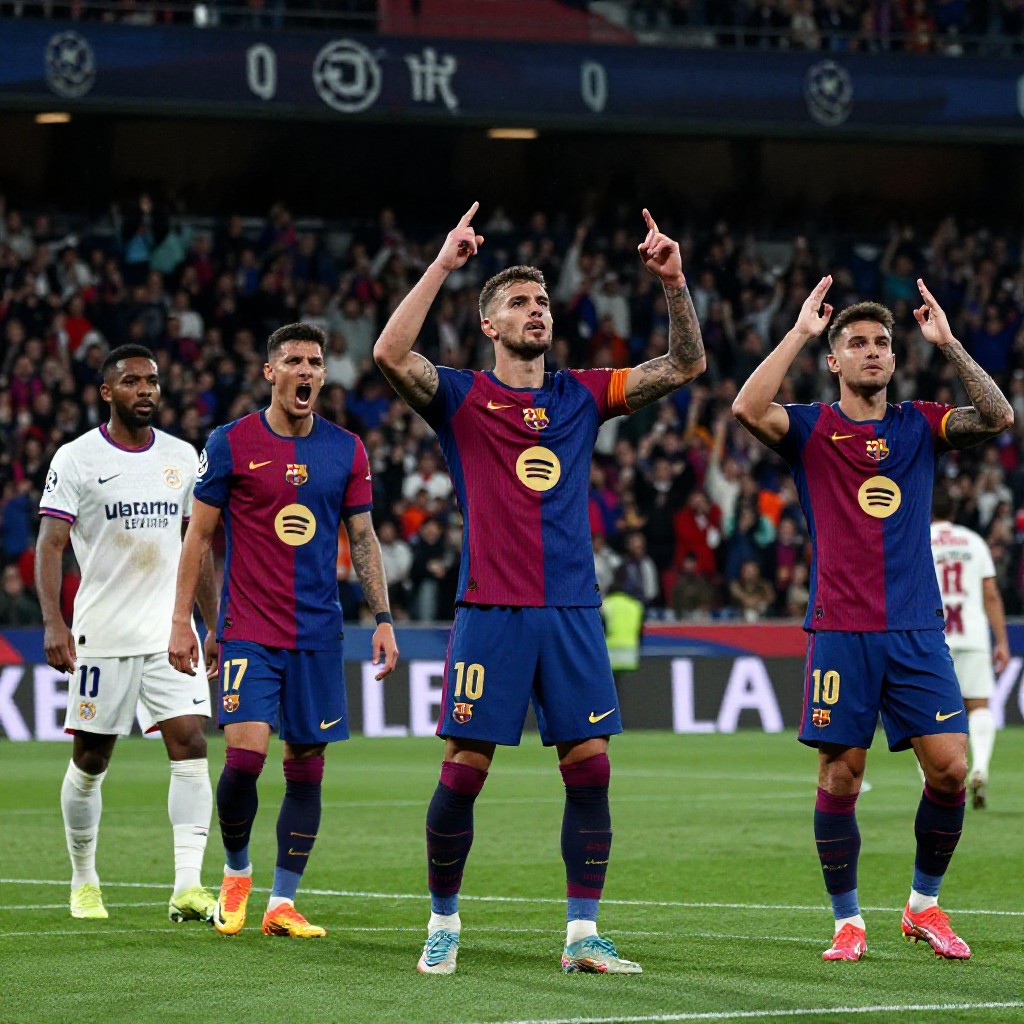
What Sports Writers Said About Galatasaray’s Defeat to Barcelona
Galatasaray took the lead at home against Barcelona but ultimately suffered a 4-1 defeat in their Champions League match. Batrakov scored the Turkish side’s only goal. The result, and the way the game shifted after the break, prompted debate among sports writers about Galatasaray’s tactics, defensive organisation and ability to cope with elite opposition.
Cem Dizdar noted that Galatasaray spent much of the first half without the ball and relied heavily on long passes. Those deliveries rarely became effective attacks, he argued, because Victor Osimhen was not yet physically ready to make the most of them. In that context, Batrakov’s goal on 28 minutes stood out as a rare, well-constructed move that contradicted the pattern of play.
The goal began with goalkeeper Uğurcan Çakır and developed through Batrakov and Leao before Batrakov finished the move. Dizdar highlighted how the attack covered the length of the pitch with quick, direct play. Barış Alper Yılmaz had also helped ease the pressure from Barcelona’s attacks. But Galatasaray’s difficulty playing out from the back under pressure soon became a major concern. Once Cancelo scored, Dizdar felt the course of the match had begun to look predictable.
Güntekin Onay focused on Barcelona’s attacking threat and the gulf between the teams. Galatasaray tried to exploit the space left by their opponents and even took the lead despite having created few clear chances. Onay suggested the score might have reached 2-0 if Osimhen’s shot had not struck Barış Alper Yılmaz. Yet Barcelona created enough opportunities to score more than four: some chances were missed, while Uğurcan made important saves.
For Onay, the decisive moment came after Barcelona went 2-1 ahead. Galatasaray’s resistance, he said, faded sharply from that point. He questioned whether Galatasaray-or another Turkish side-could compete with a team of Barcelona’s quality through open play alone. A more disciplined, compact and physically committed defensive approach might offer a better chance of staying in the contest.
Attila Gökçe identified Batrakov as Galatasaray’s most productive player, but warned that the team’s defensive security was deteriorating. He considered this a more serious problem than the side’s preference for long balls, especially because similar lapses had appeared in domestic matches. Gökçe also pointed to Torreira and Lemina, who were unable to influence the game as they normally do. Their lack of physical sharpness, he argued, can become costly in demanding fixtures.
Bülent Timurlenk praised Galatasaray’s first-half defensive work against a Barcelona side that constantly searched for gaps through its passing combinations. He singled out the space allowed to Cancelo on the left as a weakness. Barış Alper’s disallowed goal, ruled out for a narrow offside, could also have changed the match’s direction.
Timurlenk saw the opening stages of the second half as the turning point. He described Lamine Yamal’s contribution to Fermin’s headed goal as a superb piece of play, then highlighted Yamal’s close control in a duel with Eren. A further goal, attributed in his account to Gordon, followed during a damaging five-minute spell. In Timurlenk’s view, that burst wiped away much of the good work Galatasaray had produced before half-time.
Taken together, the assessments point to a match of two contrasting periods. Galatasaray showed that it could create danger with direct transitions, and its opening goal demonstrated how quickly a well-timed move could punish Barcelona. But that approach offered limited protection once possession was lost or the first line of pressure was beaten.
The defeat also exposed the risk of relying on long passes as the main route forward. If Osimhen and the other attackers cannot secure those balls, Galatasaray may quickly surrender possession and invite another wave of pressure. Against a side that moves the ball as efficiently as Barcelona, the cost of repeated turnovers can be especially high.
Defensive shape and concentration will therefore be central lessons for Galatasaray. The team needs to close the channels that allow full-backs to advance freely, while maintaining enough cover behind the midfield. A compact structure could reduce the number of dangerous situations, though it would also require disciplined coordination across the entire team.
The writers’ comments also underline how much physical condition matters in high-intensity European matches. When key midfielders cannot win duels or cover ground effectively, the defence is left exposed and the forwards become isolated. Galatasaray’s challenge is not simply to defend deeper, but to sustain its organisation and energy for the full 90 minutes.
Despite the heavy scoreline, the first-half goal and the disallowed Barış Alper effort offered evidence that Galatasaray could threaten Barcelona. The main question is whether the team can turn those moments into a more consistent plan: defend with greater security, choose its moments to press and attack space without leaving itself vulnerable at the back.