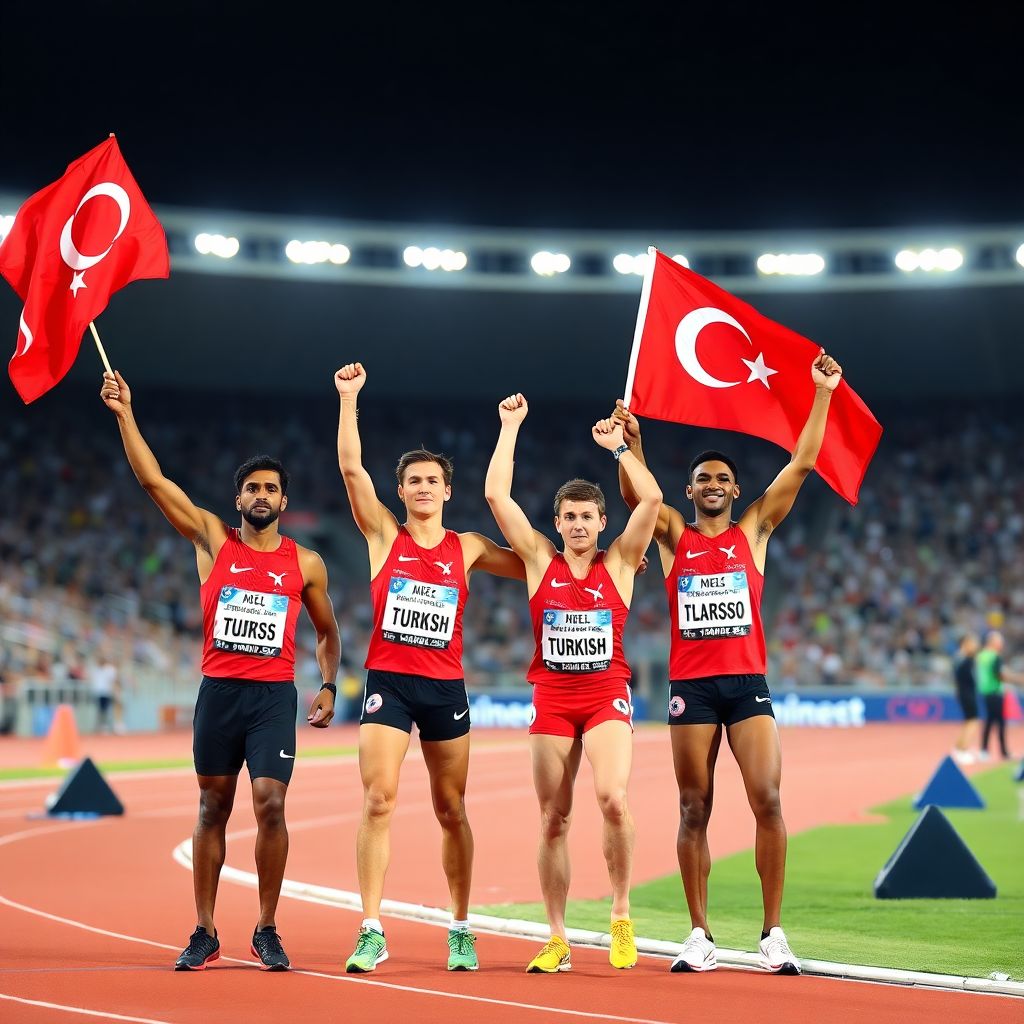
European Athletics Championships conclude: record-breaking week for Turkish team
The curtain has fallen on the 2026 European Athletics Championships in Birmingham, with Turkey leaving the competition having written several new pages in its athletics history. The national team not only returned home with a bronze medal but also set multiple national records and achieved a series of historic firsts in finals participation.
The championships, hosted in the British city of Birmingham, wrapped up on the seventh day with the final events on the track and in the field. Turkey competed with its largest delegation ever at a European Athletics Championships: 50 athletes in total, comprising 31 men and 19 women. This record participation alone signaled how seriously Turkish athletics approached these continental championships and how much the country has invested in the sport in recent years.
Among the standout performances, İsmail Nezir claimed Turkey’s only medal of the competition. Racing in the men’s 400 meters hurdles, Nezir clocked 48.26 seconds to secure the bronze medal. His run placed him on the European podium and reinforced his status as one of the most promising hurdlers on the continent. For Turkish athletics, where success in sprint and hurdle events has traditionally been limited, this bronze carries strategic importance for the future.
Another notable performance came from Esra Türkmen in the women’s javelin throw. On the final day of the championships, Türkmen reached 59.29 meters in the javelin final, finishing sixth in Europe. Though she narrowly missed the top five, her placement confirmed her consistency at major international events and demonstrated that Turkish women’s throwing events are steadily closing the gap with the European elite.
In the endurance and walking disciplines, Salih Korkmaz drew attention with a strong result in the half marathon walk. Korkmaz finished fifth in Europe, underlining his progression in a highly competitive field. On the same day, Turkey celebrated one of its most successful sessions in championship history, with a wave of national records falling in race walking events.
The sixth day of the championships turned into a record-breaking festival for the Turkish team. In the half marathon walk, Salih Korkmaz set a new national record with 1:24:45. In the women’s event, Meryem Bekmez recorded 1:36:10, also rewriting the Turkish record books. Meanwhile, in the men’s half marathon walk for another category, Hayrettin Yıldız posted 1:32:14, completing a trio of national record performances over a single day.
The marathon walk events brought further milestones. Ayşe Aslan clocked 3:43:29, setting a new Turkish national record in the women’s marathon walk. Esma Öztekin, competing in the same discipline, finished in 4:04:59, which was recognized as a new national under-23 record. These results reveal a clear trend: Turkey is beginning to emerge as a serious contender in race walking, a discipline historically dominated by a small number of European countries.
One of the most symbolic achievements of the Birmingham championships for Turkey came in the men’s triple jump. For the first time in the nation’s history, three Turkish athletes advanced from the qualifying rounds into a European Championship final in the same event. This breakthrough underlined both the growing depth of Turkey’s technical field events and the success of long-term development programs in jumps.
In that men’s triple jump final, Can Özüpek delivered the best performance among the Turkish trio. He produced a 16.73-meter jump, his best result of the season, and finished fifth in Europe. While he narrowly missed the podium, the significance of his season-best performance in a major final cannot be overstated. It showed that Turkish jumpers are now capable not just of reaching finals, but of contending for top-five positions against Europe’s strongest athletes.
On the women’s side in the triple jump, Tuğba Danışmaz also shone in the final. She recorded a jump of 14.33 meters to claim fifth place. Danışmaz has long been one of the leading names in Turkish athletics, and her result in Birmingham confirmed her as a stable force in European triple jump. Her presence in yet another major final contributes to the growing visibility of Turkish women in technical events.
The championships also delivered a historic first in the women’s discus throw. Özlem Becerek became the first Turkish female athlete ever to reach a European Championship final in this discipline. Although she did not reach the podium, simply stepping into the final round marked a turning point, signaling that Turkey is beginning to generate competitive throwers across a broader range of events.
Beyond the visible medals and records, Birmingham served as an important test of depth for the Turkish national team. Sending 50 athletes – the highest number in the country’s European Championships history – allowed many young competitors to gain invaluable experience on a major international stage. For several of them, merely qualifying for these championships or surviving the preliminary rounds will act as a springboard toward future success.
Another key takeaway from the 2026 edition is the diversification of Turkish success across disciplines. In the past, Turkey’s international results often concentrated around a few middle- and long-distance running events. In Birmingham, the country stood out not just in distance races, but also in hurdles, race walking, jumps, javelin, and discus. This variety points to a more balanced and sustainable development model in Turkish athletics.
The record-breaking day in race walking especially illustrates how targeted investments in coaching, science-based training, and infrastructure are beginning to pay off. Multiple athletes improving national records within the same discipline suggests a growing training culture and internal competition. As these walkers continue to race against the best in Europe, the gap to the continental podium could narrow even further in the coming years.
For athletes like İsmail Nezir and Tuğba Danışmaz, the Birmingham championships also act as a crucial psychological milestone. Standing in a European final, racing or jumping alongside Olympic and world medalists, and leaving with top-five finishes or a podium place, provides a strong mental foundation. This experience will be invaluable as they look ahead to upcoming World Championships and Olympic cycles.
From a broader perspective, the 2026 European Athletics Championships highlighted that Turkey’s strategic decision to field a large team was justified. The more athletes that reach heats and semifinals, the higher the chance of discovering unexpected finalists and future stars. For national coaches and federation planners, the data collected in Birmingham – from split times to technical analyses of field events – will shape training plans and talent identification programs.
The presence of three Turkish finalists in the men’s triple jump and the breakthrough of Özlem Becerek in the women’s discus final are particularly encouraging for the future of field events. These results suggest that Turkey is gradually overcoming its traditional reliance on imported talent or naturalized athletes, instead building homegrown competitors who can thrive on the European stage.
Looking ahead, the experiences gained in Birmingham will likely influence the structure of training camps, national championships, and junior development. Younger athletes who followed the championships will now have tangible role models: names like İsmail Nezir, Esra Türkmen, Tuğba Danışmaz, Özlem Becerek, and the record-breaking race walkers. Seeing Turkish athletes in multiple European finals can be a powerful motivator for the next generation.
In the end, Turkey leaves the 2026 European Athletics Championships with one bronze medal, numerous national and age-group records, several top-five finishes, and a collection of historic firsts in finals participation. While the overall medal tally may appear modest, the depth of performances and the range of events in which Turkish athletes now compete at the highest level mark Birmingham as one of the most productive European campaigns in the country’s athletics history.