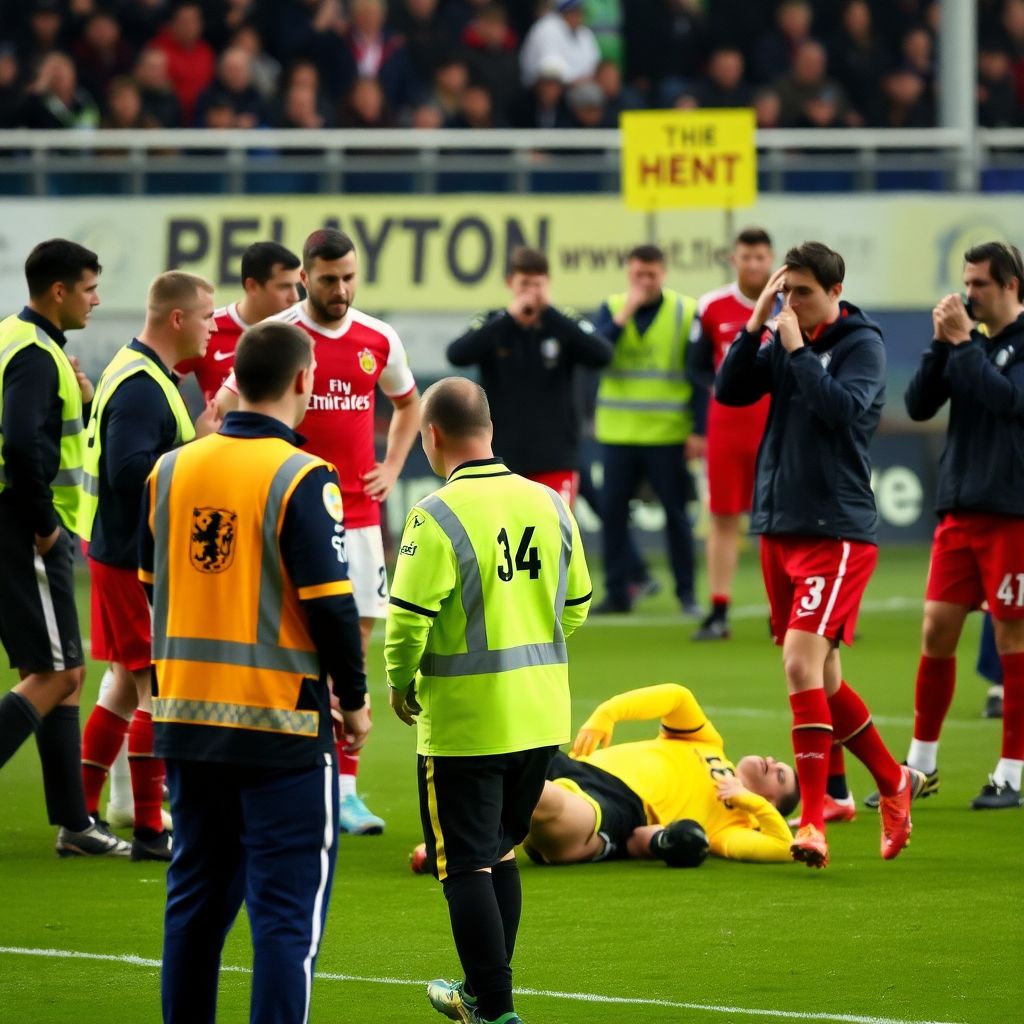
New rule on goalkeeper injuries to be trialled in England
A radical new regulation on goalkeeper injuries will be introduced in English football for the 2026-2027 season, as authorities attempt to stop teams from using injury breaks as covert tactical time-outs.
The English Football Association and Premier League confirmed that a new system designed to prevent goalkeepers’ “injuries” being used to slow down the game or pass on instructions has received approval from the International Football Association Board (IFAB). The trial will cover both men’s and women’s professional competitions throughout the entire season.
Under the new protocol, whenever play is stopped due to a goalkeeper injury, the head coach will be required to select one outfield player who must leave the pitch for at least one minute after the game restarts. The goalkeeper will be allowed to continue if fit, but the chosen teammate is obliged to stay off the field for that full period, effectively forcing the team to play temporarily with one fewer outfield player.
This measure is built on an existing IFAB provision that already applies to outfield players. Currently, if a player receives on‑field treatment and the match is halted because of that injury, the footballer must remain outside the field of play for one minute after receiving medical attention. The new experiment simply extends the logic of that rule to situations involving goalkeepers, who previously enjoyed more practical immunity from such sanctions.
The English FA stresses that the aim is not to penalise genuinely injured keepers, but to curb the growing trend of using alleged knocks as a tool to disrupt the tempo, waste time or allow coaches to reorganise their teams. When a goalkeeper goes down and requires treatment, the entire game naturally pauses, often providing a convenient window for detailed tactical talks on the touchline. The new rule seeks to restore that lost flow and reduce opportunities for gamesmanship.
However, the regulation will not be applied in every scenario. Several key exceptions have been written in to ensure player welfare remains the priority. The new measure will not come into force if the goalkeeper needs treatment following a foul, if the keeper and an outfield player collide and both require medical assistance, if there is visible bleeding, or if emergency treatment is required after a physical challenge that has already been punished with a free-kick. In such cases, the focus will remain entirely on medical care rather than competitive balance.
The trial will officially start on 1 August, coinciding with the opening round of the League Cup. From that date, clubs, coaches, players and referees will begin adapting to the new procedures, which will then run across the full 2026-2027 campaign in domestic professional football.
This goalkeeper measure is only one element of a much broader initiative aimed at cutting down on time-wasting. As part of the same package, throw-ins and goal kicks will be subject to a strict five‑second countdown to discourage delays, while substitutions will come with a 10‑second limit for players leaving the pitch once their number is shown. The overall objective is to keep the ball in play longer, speed up restarts and provide a more continuous spectacle for supporters in the stadium and watching on television.
Why focus on goalkeeper injuries?
In modern football, goalkeepers have become central to game management. When a team is under pressure, a keeper going down for “treatment” can break the opponent’s momentum, allow defensive lines to reset and give coaches time to shout detailed instructions. Because only one goalkeeper exists on each team and their role is unique, referees have historically been more cautious about forcing them off the field, which has made this a particularly attractive tactic for sides trying to protect a lead.
By attaching a concrete cost to such stoppages – temporarily losing an outfield player – the authorities hope to make clubs think twice before encouraging exaggerated or theatrical injury breaks from their keepers. If a team risks defending with fewer players, the supposed benefit of slowing the game is partially offset by the danger of conceding once play resumes.
Potential impact on tactics and coaching
The new rule is likely to influence how managers approach match control, especially in tight games late on. In the past, a goalkeeper sitting down after a long spell of pressure could effectively reset the contest. Under the trial, that same decision could leave the team defending with only nine outfield players for a minute, precisely when concentration and numbers in defence are most crucial.
Coaches may respond by demanding better physical and mental resilience from their goalkeepers and medical staff might be stricter in distinguishing genuine injuries from discomfort that can be managed without stopping the game. At the same time, teams may increasingly rely on planned tactical signals or pre‑agreed adjustments rather than ad‑hoc instructions during stoppages.
How referees and medical teams will be affected
Match officials will find themselves under even greater scrutiny as they judge whether a goalkeeper’s treatment falls under one of the exceptions. The line between a foul‑induced injury and a routine knock can be thin, and referees will need clear guidance and consistent interpretations to avoid controversy.
Medical personnel will also be in a delicate position. On one hand, they must react quickly to any potential head injury, serious collision or bleeding. On the other, they will be aware that their intervention can place their team at a numerical disadvantage if the situation does not meet the exemption criteria. The authorities insist that medical judgement must remain independent and that player safety cannot be compromised by tactical considerations.
Comparison with existing measures against time-wasting
Football’s lawmakers have been searching for ways to reduce time-wasting for years. Booking goalkeepers for taking too long over goal kicks, adding generous amounts of stoppage time and insisting players leave the pitch at the nearest point during substitutions are all part of this evolution. The new goalkeeper rule fits into this trend but goes a step further by attaching a tangible tactical penalty to certain stoppages rather than relying solely on yellow cards or added time.
The five‑second limit on throw‑ins and goal kicks, combined with the 10‑second restriction on players exiting the field during substitutions, signals a clear determination to change player behaviour. When combined with the goalkeeper-injury rule, the message is that every deliberate attempt to slow the game will either cost time, numbers on the pitch or disciplinary sanctions.
Possible reactions from clubs and players
Clubs are likely to react with a mix of caution and curiosity. Teams that rely heavily on structured defensive blocks and game management may initially be more critical, fearing they will lose one of their tools for protecting a narrow advantage. Attack‑minded sides, meanwhile, may welcome anything that keeps the ball in play and reduces stalling tactics they often encounter when chasing a result.
Goalkeepers themselves might feel unfairly targeted, arguing that their position naturally involves more physical contact, high‑impact landings and awkward dives that genuinely require treatment. They may also point out that, in many cases, it is the medical team or the referee who decides whether play must stop. The trial period will be crucial for collecting data on how often the rule is triggered and in what situations.
What this could mean for the flow of the game
If applied consistently, the regulation could significantly alter the rhythm of matches. Teams will know that turning a minor knock into a prolonged stoppage may no longer be worth the risk. In theory, the number of unexplained or exaggerated goalkeeper injuries in the closing stages of games should decline, leading to fewer long pauses and more continuous pressure phases.
Spectators might notice quicker restarts, less arguing with referees over small delays and a more intense pace overall, especially in the last 15-20 minutes of matches when time-wasting has traditionally been most common. For broadcasters and sponsors, a more fluid game with fewer dead moments is also commercially attractive.
Looking ahead: from experiment to potential global change
The 2026-2027 season will serve as a large‑scale laboratory for this new approach. Data will be collected on stoppage lengths, the number of times the rule is applied, the impact on injuries and any unintended consequences for player welfare or match integrity. IFAB will then review the evidence before deciding whether to recommend that the regulation be integrated into the formal Laws of the Game for worldwide use.
If deemed successful, the experiment in England could become a blueprint for other leagues looking to modernise football’s relationship with time-wasting and tactical gamesmanship. If it proves problematic or detrimental to genuine injury management, it may instead serve as a lesson in the limits of regulatory intervention.
In any case, the forthcoming season in English football will provide an important insight into how far the sport is willing to go to protect its tempo – even when that means fundamentally changing how goalkeeper injuries are handled.