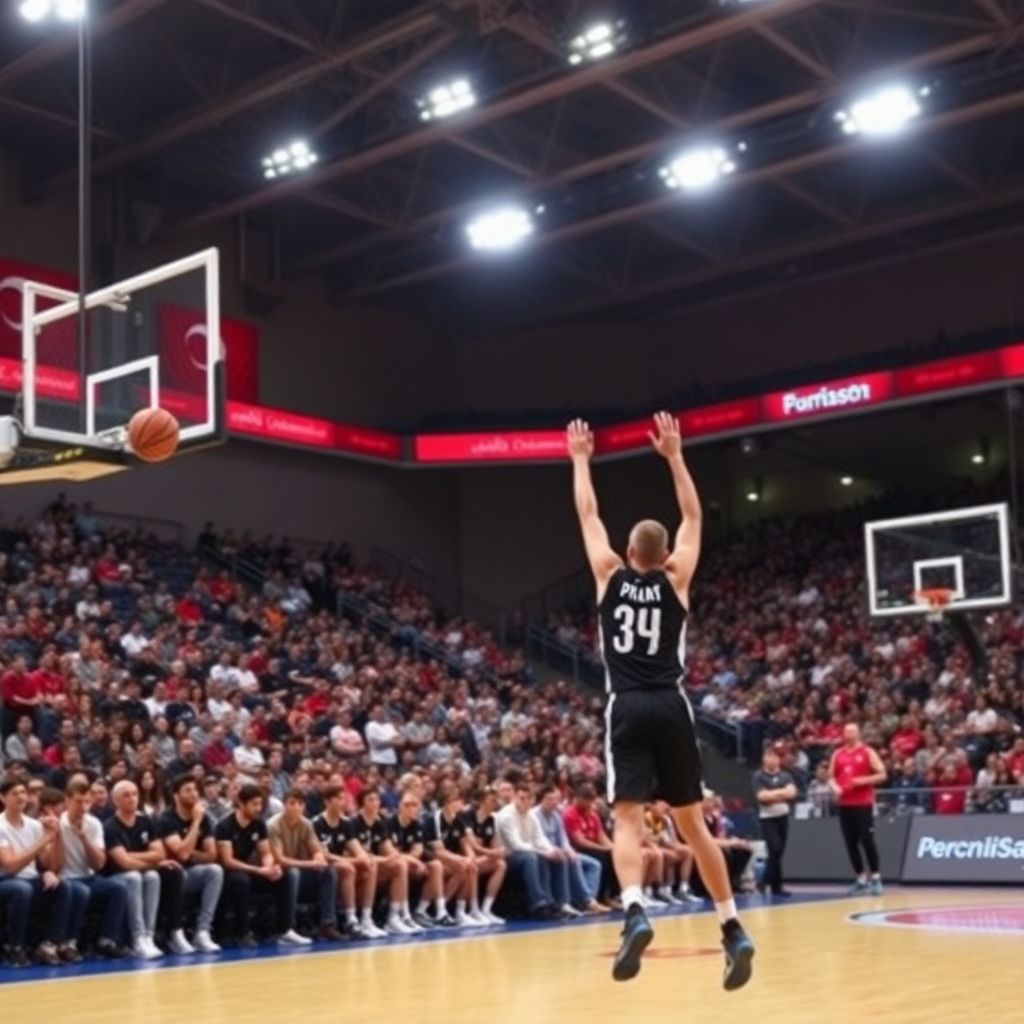
12 Giant Men set to close first round against Switzerland in World Cup qualifiers
Turkey’s men’s national basketball team is preparing to put the final stamp on a flawless first phase in the FIBA 2027 World Cup European Qualifiers. In the sixth and last game of Group C in the first round, the “12 Giant Men” will host Switzerland, aiming to finish the group stage with a perfect record.
The matchup will be played at Sinan Erdem Sports Hall, with tip-off scheduled for 19:00. Turkey, already assured of both a place in the second round and first place in the group, now targets a symbolic but prestigious goal: a 6‑for‑6 run that would underline their dominance in this stage of the competition.
Turkey on top, Switzerland anchored to the bottom
Turkey enters the encounter as the clear group leader, having won all five of its games so far. The red-and-white side secured passage to the second round after its fourth victory and mathematically sealed first place in Group C with its fifth win. Their consistent performances, both home and away, have allowed head coach Ergin Ataman to control the rotation without jeopardizing results.
On the opposite end of the standings, Switzerland sits in fourth and last place. The Swiss have lost all five of their games in the group and are already out of contention for the next round. For them, the trip to Istanbul is more about pride, experience and a chance to finish the campaign with a competitive display than about qualification scenarios.
For Turkey, however, the objective is clear: assert themselves from the opening minutes, avoid a drop in intensity and complete the first phase undefeated. Clinching a 6‑0 record would not only be a confidence boost but also send a message to future opponents as the battle for World Cup spots intensifies.
Turkish roster under Ergin Ataman
The national team, coached by the experienced Ergin Ataman, approaches the game with a deep and versatile squad. The preliminary roster features a strong mix of NBA talent, EuroLeague experience and promising local players capable of covering multiple positions on the floor.
The current candidate list includes:
Adem Bona, Alperen Şengün, Ercan Osmani, Erkan Yılmaz, Şehmus Hazer, Kenan Sipahi, Malachi Flynn, Berk İbrahim Uğurlu, Sertaç Şanlı, Yiğit Arslan, Tarık Biberovic, Yiğit Onan, Furkan Korkmaz, Yiğitcan Saybir, Cedi Osman, Ömer Faruk Yurtseven, Emre Melih Tunca.
With frontcourt options such as Alperen Şengün, Sertaç Şanlı, Adem Bona and Ömer Faruk Yurtseven, Turkey can dominate the paint, control the boards and attack the rim relentlessly. On the perimeter, scorers like Furkan Korkmaz and Cedi Osman, combined with playmakers such as Kenan Sipahi and Malachi Flynn, give Ataman flexibility in both half-court sets and transition offense.
This depth allows the coaching staff to test different lineups against Switzerland: big units focusing on inside power, small-ball combinations for higher tempo, or defensive-minded quintets to pressure the ball and create easy points from turnovers.
Turkey on the brink of another historic milestone
The clash with Switzerland will also carry special symbolic value in the broader history of Turkish basketball. The national team is set to play the 1063rd game in its history, extending a journey that began nearly nine decades ago.
Turkey’s men’s team played its first-ever game on 24 June 1936 against Greece. Since that day, over roughly 90 years, the national side has appeared in 1062 official and friendly encounters. From those games, Turkey has recorded 552 victories and suffered 509 defeats, with a single draw on its record.
That solitary draw came on 13 June 1995, in Istanbul, in a friendly against Macedonia that ended 78-78. It remains a statistical curiosity in an era when draws in basketball are increasingly rare due to overtime rules and tournament formats.
First official victory: a turning point in Egypt
The path to becoming a regular contender in European and world basketball was not easy for Turkey. The national team’s first official win came in 1949 at the European Championship held in Egypt. After losing its opening two games of that tournament against Greece and France, Turkey found its first taste of victory in official competition by defeating Syria in the third matchup.
That historic success marked a psychological shift: it showed that the national team could compete at continental level and laid the groundwork for later generations. From that moment on, Turkish basketball started to build an identity based on resilience, physicality and a passionate fan base.
Biggest wins and heaviest defeats in national team history
Over the decades, Turkey’s results have swung from unforgettable wins to painful defeats, each helping shape the national team’s character.
The most lopsided victory in Turkish men’s national team history came against Libya. At the Islamic Nations Sports Games held in İzmir on 29 September 1980, Turkey cruised to a 142-45 win, a staggering 97‑point margin. That game remains a reference point whenever historical records and scoring differences are mentioned.
On the other side of the spectrum, Turkey has also endured heavy defeats. One of the most significant came on 24 June 1993 at the 28th European Championship in Germany, where the national team fell 113-63 to Croatia, a 50‑point loss. Many years later, on 3 July 2024, another big defeat entered the record books when Turkey lost 96-46 to France in an away preparation game. These results, though painful, have often been used as lessons, pushing the program to raise its standards in physical preparation, tactical sophistication and squad depth.
What’s at stake against Switzerland?
From a strictly mathematical standpoint, the game against Switzerland does not change Turkey’s qualification status. The team is already through to the next stage and locked into first place in Group C. Yet the encounter remains important on several levels.
First, maintaining a perfect record keeps the winning culture alive. Heading into the second round with a 6‑0 run reinforces the belief within the locker room and boosts the aura of the team in the eyes of future opponents. Second, the match is an opportunity to polish offensive and defensive schemes under real competition conditions, rather than in training sessions or friendlies.
Third, players fighting for minutes and a stable role in the rotation see this as a chance to prove their value. Young names can earn trust, while experienced stars can fine-tune their rhythm. For the coaching staff, it is an ideal setting to test combinations that might be decisive in tougher games down the road.
Tactical keys: how Turkey can impose its game
On paper, Turkey has clear advantages in height, physicality and individual talent. Translating that into a dominant performance depends on focus and execution. Protecting the ball, minimizing turnovers and setting the defensive tone early will be crucial.
With big men like Şengün, Şanlı, Bona and Yurtseven, Turkey can control the inside, contest shots, and limit Switzerland’s second-chance points. If the defense secures the rebound consistently, the team can trigger fast breaks where athletic wings such as Korkmaz, Osman and Biberovic become extremely dangerous in transition.
In half-court offense, spacing will be key. Effective outside shooting from guards and forwards will open driving lanes, forcing the Swiss defense to stretch and creating mismatches inside. Meanwhile, playmakers like Sipahi and Flynn will be responsible for orchestrating the pick‑and‑roll, exploiting mismatches and keeping the ball moving to tire out the opposition.
Psychological dimension and home-court factor
Playing at Sinan Erdem Sports Hall gives Turkey a clear emotional and psychological advantage. Over the years, the arena has hosted numerous memorable games for club and country, often generating an intense atmosphere that weighs on visiting teams.
For Switzerland, facing a motivated opponent backed by a large and vocal crowd will be a test of composure. For Turkey, the challenge is different: to avoid complacency, maintain professional focus and respect the opponent regardless of the standings. Historically, the national team has learned that underestimating any rival in international basketball can lead to unnecessary complications.
Managing minutes and player health
With the main objectives of the first round already secured, another important theme for the coaching staff will be managing playing time. Keeping key players healthy and fresh for the tougher stages ahead is essential. The match against Switzerland could therefore see wider rotation and longer runs for players who have had fewer minutes so far in the campaign.
This approach allows the technical team to evaluate different roles: which combinations defend best on the perimeter, which frontcourt pairings complement each other, and which bench players can adapt quickly to high-pressure situations. At the same time, it reduces the risk of fatigue and minor injuries that could become problematic later in the qualifiers.
Long-term outlook for Turkey in the World Cup race
The broader goal extends far beyond Group C. Turkey’s ambition is to be present at the 2027 FIBA World Cup and to arrive there as a competitive, well‑balanced team capable of challenging the biggest basketball nations. The current generation offers a promising mix: NBA experience, European club success and a new wave of athletic, versatile players coming through.
The perfect first round, if completed with a win over Switzerland, would be an important stepping stone on this longer journey. Consistent performances, a clearly defined playing identity and the growth of younger players within the national setup are all elements that can determine whether Turkey not only qualifies for the World Cup but also makes a deep run when the tournament arrives.
As the 12 Giant Men step onto the court for their 1063rd game in national team history, they carry both the weight of tradition and the hope of a new chapter. A flawless end to the first round against Switzerland would be another brick in the foundation of that future.