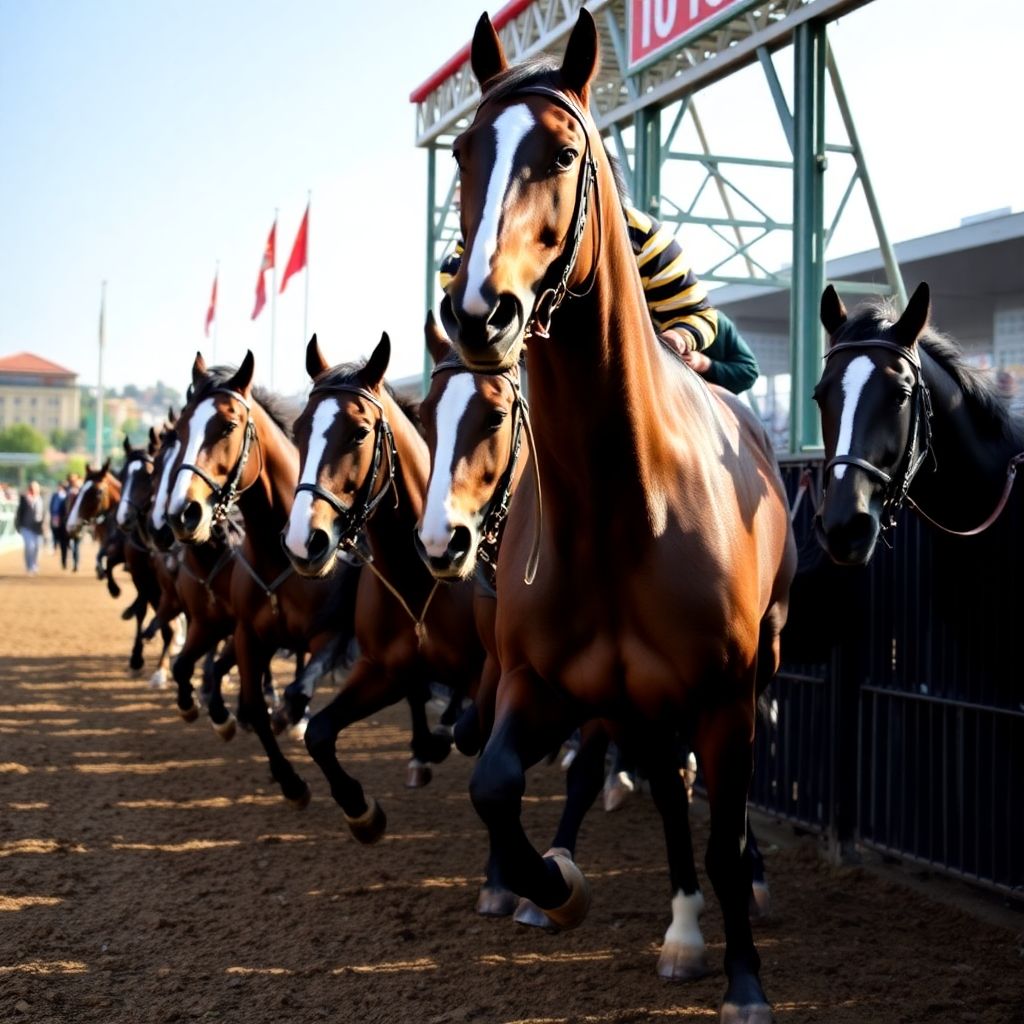
100th Gazi Race: Centennial Derby Thrill in Istanbul
The most prestigious event in Turkish horse racing, the Gazi Race, celebrates its 100th running today, marking a milestone for both the sport and the country’s modern history. Held in honor of Mustafa Kemal Atatürk since 1927, the centennial edition of the Turkish Derby will take place at Istanbul’s Veliefendi Racecourse, where excitement has been building for weeks.
The race is scheduled to go off at 17:15 at Veliefendi, the historic heart of Turkish thoroughbred racing. As always, the Gazi is open exclusively to three-year-old thoroughbred English horses, and each contender gets just one lifetime chance to compete in this legendary 2,400-meter turf contest. This year, 22 runners will line up in the starting gates, each paired with a top jockey chasing immortality as the winner of the 100th Gazi.
Runners and jockeys for the 100th Gazi Race
The field for today’s centennial edition brings together some of the most talented horses and riders in the country. The horse-jockey pairings are:
– Aimus Liberatus – Özcan Yıldırım
– Almighty Esprit – Salih Çelik
– Anshba – Ayhan Kurşun
– Ballad King – Akın Sözen
– Bay Nalçakan – Halis Karataş
– Brando – Ertuğrul Çizik
– Ersele Beyi – Ercan Çankaya
– Goldrakhan – Muhammed Mir Bilgin
– Jazz Runner – Fırat Ramazan Bebek
– Joyful Forever – Selim Kaya
– Kralın Dansı – Hışman Çizik
– Mandrake – Müslüm Çelik
– Massimo Supremo – Erhan Aktuğ
– Metal Heart – Mehmet Akif Solmaz
– Mucho Bueno – Vedat Abiş
– Rabovo – Ahmet Çelik
– Silent Treatment – Mehmet Akyavuz
– The Real One – Mehmet Salih Çelik
– Upamecano – Gökhan Kocakaya
– Whizbang – Sadettin Boyraz
– Jaehaera – Ali Yıldız
– Neuro Math – Mehmet Kaya
Every name on this list carries its own story: promising bloodlines, ambitious owners, and jockeys who have spent months preparing for a race that can define an entire career. For some riders, a Gazi victory would crown an already remarkable resume; for others, it could be the breakthrough moment that changes their professional life.
How the Gazi Race was born
The origins of the Gazi Race go back to the years of the War of Independence. During that time, Mustafa Kemal Atatürk personally oversaw horse racing events in Ankara, recognizing the cultural and social importance of the sport. In 1927, he gave the order for a special race to be organized in his honor – the Gazi Race, named after his title “Gazi” (veteran, victor).
Atatürk repeatedly emphasized that horse racing was a social necessity for modern societies. Whenever his busy schedule allowed, he followed the races at the racecourse, underlining how closely the early Republic’s leadership was connected to equestrian sports and breeding.
The very first Gazi Race was run on 10 June 1927 over a distance of 2,000 meters. The winner’s prize was set at 2,000 lira, a significant sum at the time and a signal of how seriously the event was regarded from day one. That inaugural edition was won by “Neriman,” a thoroughbred owned by Ali Muhiddin Hacıbekir and ridden by jockey İhsan Atçı. Mustafa Kemal Atatürk and İsmet İnönü watched the race together from the stands, giving the event a symbolic weight that would echo through the decades.
From Ankara to Istanbul: milestones of a classic
In the years that followed, the Gazi Race quickly grew into the absolute pinnacle of Turkish flat racing. Presidents themselves became part of the story: İsmet İnönü’s horse “Olgo” and Celal Bayar’s “Cap Gris Nez” both managed to win the race, underlining how the country’s political and social elite were strongly represented among owners and breeders.
A major turning point came in 1968, when the Gazi Race was staged in Istanbul for the first time. That year, victory went to “Asuvan,” owned by Burhan Karamehmet, marking the beginning of the modern Gazi era at Veliefendi. From then on, the Istanbul racecourse became inseparable from this classic, and generations of racing fans have since associated the Gazi with the Veliefendi turf.
Another important symbol of the race is the trophy itself. Since 1970, the winner has received a solid silver statue of Atatürk on horseback, the official prize of the Gazi Race. The sculpture, created by renowned artist Assoc. Prof. Dr. Şadi Çalık, has become one of the most coveted trophies in Turkish sports. The first owner to lift this iconic statue was Sadun Atığ, thanks to his horse “Sadettin.”
Records that shaped the legend
Over the past century, the Gazi Race has produced unforgettable performances. The fastest time in the history of the race belongs to the legendary “Bold Pilot.” In 1996, this remarkable horse, owned by Özdemir Atman and ridden by star jockey Halis Karataş, completed the 2,400 meters in 2:26.22. That run not only secured victory that day but also set a record that still stands as the benchmark in the Gazi’s long history.
When it comes to success in the saddle, one name towers over the rest: Mümin Çılgın. He is officially the most successful jockey in Gazi Race history, with nine wins to his name. Çılgın triumphed aboard:
– Helene De Troia (1960)
– Apaçi (1965)
– Nadas (1974)
– Dr. Seferof (1979)
– Dersim (1981)
– Uğurtay (1985)
– Hafız (1986)
– Top Image (1988)
– Abbas (1991)
This extraordinary record made him a living legend of Turkish racing and set a standard that seemed almost impossible to match.
Among owners and stables, the most successful partnership is the Eliyeşil stable, which has captured the Gazi 13 times. Their winners are:
– Darling (1950)
– Kusun (1953)
– Atlıhan (1961)
– Melikşah (1963)
– Kayarlı (1964)
– Minimo (1971)
– Akkor (1972)
– Karayel (1973)
– Buğra (1976)
– Toraman (1982)
– Cartagena (1984)
– Hafız (1986)
– Popular Demand (2005)
This dominance reflects decades of investment in breeding, training, and careful selection of bloodlines – a long-term vision that continues to influence Turkish thoroughbred breeding today.
The modern era: Ahmet Çelik and the streak that made history
Among active jockeys, Ahmet Çelik stands out as the dominant figure of recent years. He has won the Gazi Race eight times, more than any other currently active rider. Even more astonishing is his streak of consecutive victories: Çelik holds the record for the most back‑to‑back Gazi wins, with seven in a row.
His incredible run began with:
– 89th Gazi: “Renk”
– 90th Gazi: “Graystorm”
– 91st Gazi: “Piano Sonata”
– 92nd Gazi: “Hep Beraber”
– 93rd Gazi: “The Last Romance”
He continued his dominance with:
– 94th Gazi: “Call To Victory”
– 95th Gazi: “Burgas”
Seven consecutive Gazi victories transformed Ahmet Çelik from a successful jockey into a figure firmly inscribed in the sport’s history. Only a few riders in the world have achieved anything comparable in their national derbies.
Veteran star Halis Karataş, another iconic name in Turkish racing, has also left a deep mark with six Gazi victories. Beyond wins, his partnership with Bold Pilot remains one of the most beloved stories among racing fans, often cited as the perfect combination of talent, heart, and race sense.
An earlier era had its own dominant figure: the unforgettable jockey Ekrem Kurt. In the early 1970s, he managed to win the Gazi three years running – 1971, 1972, and 1973 – a feat that stood as a benchmark for consistent excellence in its time.
Special prize pool for the 100th edition
To underline the exceptional status of this year’s centennial race, an unprecedented prize pool has been announced. The first‑place purse for the 100th Gazi Race is 50 million lira. The runner‑up will receive 20 million lira, third place 10 million lira, fourth place 5 million lira, and fifth place 2.5 million lira.
But the rewards for the winning connections go even further. The owner of the winning horse will earn, in addition to the first‑place purse, the 100th Year Gazi Race Special Award, as well as income from entry fees, installment payments and the owner’s premium. Altogether, this adds up to a total of 126,870,000 lira for the winner’s owner. If the owner is also the breeder of the winning horse, then a breeder’s premium will be added on top of that already impressive amount.
These figures not only reflect the prestige of the event but also its economic significance. The Gazi is no longer just a sporting contest – it is a powerful driver for the horse breeding and racing industry, encouraging investment in young horses, training facilities, and professional expertise.
Beyond the money: what makes the Gazi unique
Even with the record prize pool, most people around the sport agree that the greatest reward is not financial. Owners, trainers, jockeys and breeders strive for years to see their colors carried to victory in the Gazi because it offers something money cannot buy: a permanent place in the history of Turkish racing.
For breeders, a Gazi win dramatically increases the value of a stallion or broodmare line, shaping breeding decisions for many seasons. For trainers, it is the ultimate proof of their method and patience, showing they can guide a young horse to peak exactly on the biggest day. And for jockeys, having “Gazi winner” next to their name is often enough to define their entire career in the public eye.
The atmosphere at Veliefendi on Gazi day
Gazi day at Veliefendi is unlike any other race meeting of the year. The grandstands are traditionally packed with fans, families, and long‑time racing enthusiasts who view attendance almost as a ritual. Many spectators dress elegantly, turning the day into a social event as well as a sporting one.
In the hours leading up to the Gazi, earlier races on the card help build the atmosphere. In the parade ring, the Gazi contenders circle in front of owners and fans, who scrutinize every detail – muscle tone, calmness, how the jockey sits, how the horse walks. Applause often breaks out for popular horses, trainers, or riders.
As the Gazi field moves toward the starting gates, tension peaks. Silence falls for a brief moment, broken only by horses snorting and jockeys giving last instructions to their mounts. When the gates open and the commentator’s voice rises over the noise of the crowd, months – sometimes years – of planning and dreaming come down to a two‑and‑a‑half‑minute test.
Tactical challenges of the 2,400‑meter Gazi trip
The Gazi distance of 2,400 meters on turf may seem straightforward, but it poses a complex tactical challenge. Jockeys must judge pace perfectly: go too fast early and a horse will tire in the long home straight; sit too far back and there may not be time to thread a clear path through tiring rivals.
Three‑year‑olds are still developing physically and mentally, so the race also tests temperament. Some horses get nervous in front of the enormous crowd; others grow in confidence from the roar of the stands. A calm, focused jockey can make the difference, settling a tense horse and saving energy for the final turn.
Track conditions matter as well. On firmer ground, speed and acceleration tend to dominate, favoring horses with a sharp turn of foot. On softer going, stamina becomes crucial, and horses with strong staying pedigrees usually gain an edge. Trainers often tailor their entire preparation to the likely ground on Gazi day.
The Gazi as a mirror of Turkish modernization
From its creation under Atatürk’s patronage to its modern‑day centennial, the Gazi Race has reflected broader changes in Turkish society. In the early Republic, it symbolized a push toward modern sports culture and structured breeding. Later, it mirrored economic growth, as prize money and investments increased.
Today, the Gazi brings together different generations: older fans who remember the greats of the past and younger audiences who follow current stars through television and digital platforms. It serves as a bridge between tradition and modernity, combining a century‑old ritual with contemporary professional standards in training, medicine and race management.
What the 100th Gazi means for the future
The 100th running is more than a commemorative date on a calendar. It marks a turning point and raises expectations for the future of Turkish horse racing. A successful centennial edition – with high‑class competition, strong organization and compelling stories – can boost interest in the sport among new audiences and encourage fresh investment at every level.
For the participants, winning today’s race would carry a special weight. The victorious horse, jockey, trainer and owner will not only be listed among past winners but will forever be remembered as the champions of the centenary Gazi. For many, that alone makes the 2,400‑meter challenge at Veliefendi the most important race of their lives.