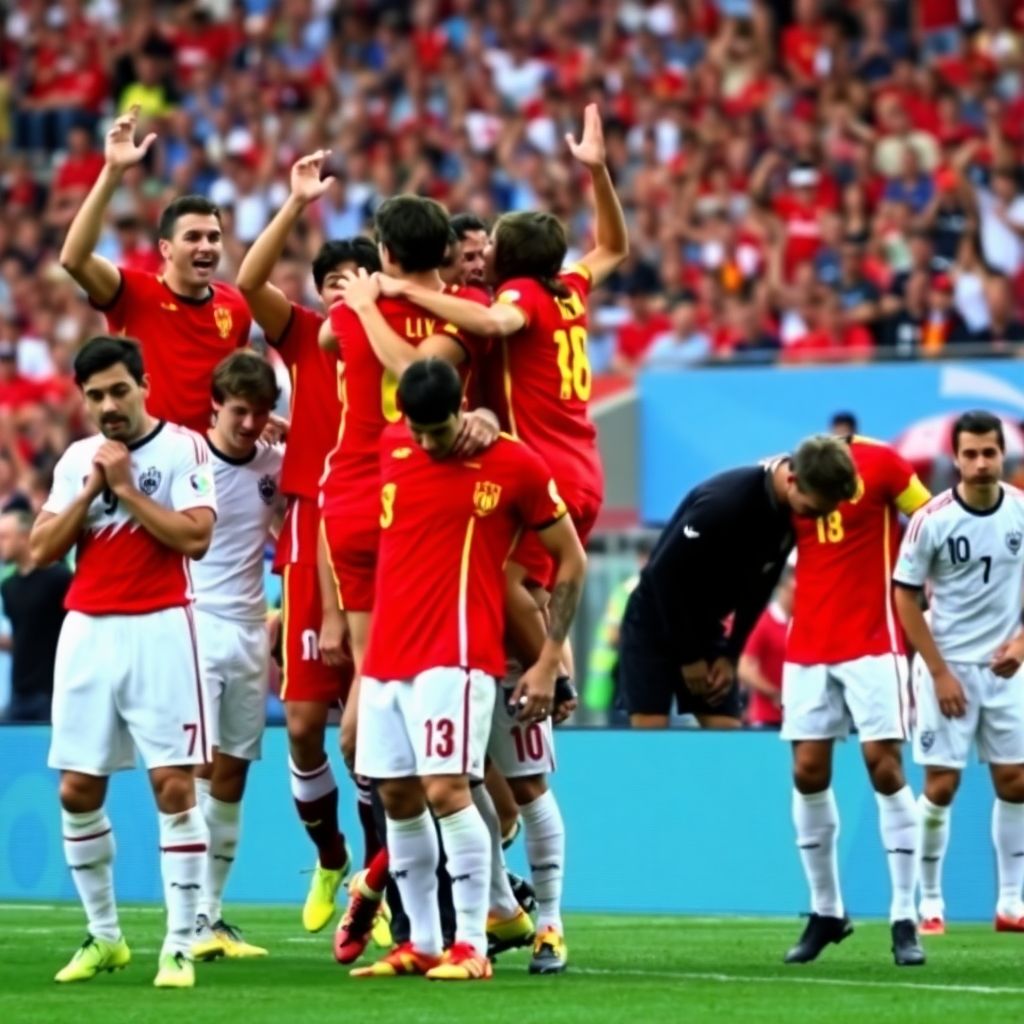
Belgium finish top of their group after crushing New Zealand 5-1
Belgium comfortably booked their place in the last 32 of the 2026 World Cup, demolishing New Zealand 5-1 in the final round of Group G matches and climbing to first place on goal difference ahead of Egypt. New Zealand, meanwhile, saw their campaign come to an end, exiting the tournament at the group stage with just a single point.
The decisive encounter was played at BC Place Stadium in Vancouver, where Belgium arrived knowing that only a convincing win would guarantee control of their own destiny. From the opening minutes it was clear Rudi Garcia’s side had come to dominate the ball and the tempo, and the breakthrough arrived just before the half-hour mark.
In the 28th minute, Leandro Trossard opened the scoring, putting Belgium 1-0 ahead. The forward exploited the space between New Zealand’s lines, timing his run perfectly to meet a clever pass and finish clinically. Belgium’s patient build-up and constant movement finally paid off, and the early goal forced New Zealand to abandon their conservative approach.
The first half concluded with that single-goal advantage, but the margin hardly reflected Belgium’s control. They circulated the ball with composure, pressed aggressively after losing possession and repeatedly forced New Zealand’s back line into hurried clearances. The Oceania side hung on, hoping to find a way back after the break, but the second half turned into a one-sided affair.
Belgium came out for the restart with even more intensity, immediately pinning New Zealand deep in their own half. Just five minutes into the second period, Trossard struck again. In the 50th minute he doubled both his personal tally and his team’s lead, finishing off another sweeping move to make it 2-0. At that point, New Zealand’s resistance visibly began to crack, and Belgium sensed the opportunity to settle the game for good.
The third Belgian goal arrived in the 66th minute through Kevin De Bruyne, who added the composure and precision that have long defined his international career. Arriving from midfield, De Bruyne found space on the edge of the box and calmly slotted the ball home, pushing the score to 3-0 and effectively killing off any realistic hope of a New Zealand comeback. Belgium, already dominant, now played with freedom and confidence, rotating positions and exploiting every gap that appeared.
New Zealand refused to surrender completely and finally found a lifeline late in the match. In the 84th minute, Just reduced the deficit to 3-1, briefly lifting his team and reminding Belgium that lapses in concentration can still be punished. Yet any hint of suspense lasted barely two minutes.
Only moments after New Zealand’s goal, substitute Romelu Lukaku wrote his own line in the script. Introduced from the bench, he scored in the 86th minute with his very first touch of the ball. The powerful striker imposed himself inside the penalty area, met a cross and immediately restored Belgium’s three-goal cushion, making it 4-1. His impact underlined the incredible depth at Garcia’s disposal in attacking positions.
In stoppage time, Belgium added a final flourish. Alexis Saelemaekers, another player who brought energy from the bench, struck in the dying moments of the match, with his goal in added time setting the final score at 5-1. The late strike was not just cosmetic: those extra goals proved crucial for the group standings, boosting Belgium’s goal difference and pushing them ahead of Egypt at the top of Group G.
With this emphatic victory, Belgium finished the group stage on five points, level with Egypt but ahead thanks to superior goal difference. That fine margin turned out to be decisive, as topping the group offers a more favourable path in the knockout rounds and a psychological boost for a team that hopes to go deep into the tournament. New Zealand, on the other hand, remained stuck on one point and bid farewell to the World Cup after failing to win any of their three matches.
Under coach Rudi Garcia, the Red Devils showed a more balanced version of themselves compared with some previous tournaments. The attack was incisive, but the structure behind the ball was also more stable. Garcia rotated his squad intelligently, using fresh legs like Saelemaekers and Lukaku at the right moments to maintain intensity and exploit a tiring opponent. The ability to bring such quality from the bench is one of Belgium’s main weapons heading into the knockout phase.
By winning the group, Belgium set up a round-of-32 clash against one of the teams that finished third in Groups A, E, H, I or J and ranked among the best third-placed sides. This scenario may look favourable on paper, but history has repeatedly shown that knockout matches against supposedly weaker opponents can be treacherous. Garcia and his staff will be aware that any drop in focus could be punished, particularly once the margin for error disappears.
One of the evening’s most significant stories unfolded not in attack, but in goal. Thibaut Courtois, the experienced Real Madrid goalkeeper, reached a historic milestone for his country. At 34 years old, he became the Belgian player with the most World Cup appearances, surpassing the previous record held by Enzo Scifo. This achievement places Courtois firmly among the all-time greats of Belgian football, highlighting both his longevity and his consistent performances on the biggest stage.
Courtois’s record also underlines a broader truth about Belgium’s so-called “golden generation”: while some stars have already retired or are in the final chapters of their careers, the core remains fiercely competitive. Players like De Bruyne and Lukaku continue to drive the team forward, while figures such as Trossard and Saelemaekers signal a transition towards a new wave of talent. The win over New Zealand displayed this blend of experience and renewal in striking fashion.
From a tactical perspective, Belgium’s approach against New Zealand was a textbook example of how to dismantle a compact defence. They stretched the pitch with wide players, constantly shifted the point of attack, and used De Bruyne’s intelligence between the lines to pull defenders out of position. The timing of Trossard’s runs, combined with the late arrivals from midfield, created numerical superiority around the box and led directly to several of the goals.
For New Zealand, the result is painful but not entirely without positives. Reaching the World Cup and competing in such an environment provides invaluable experience for players who rarely face elite opposition on a regular basis. Their single point in the group might look modest, yet the lessons learned against a team of Belgium’s calibre could shape the development of New Zealand football in the coming years. The challenge now will be to build on this appearance rather than allowing it to be an isolated achievement.
Looking ahead, Belgium’s main task will be to maintain the attacking fluency seen in Vancouver while tightening any occasional lapses at the back. The 5-1 scoreline may appear overwhelming, but conceding a goal at 3-0 will likely be a detail that Garcia and his coaching team do not ignore. Against stronger opposition in the knockout rounds, such moments can change the entire story of a match.
Psychologically, however, a high-scoring win in the final group game can serve as a powerful springboard. Confidence among the forwards will be soaring: Trossard leaves the match with a brace, De Bruyne has reaffirmed his status as an on-field leader, Lukaku has scored immediately upon entering, and Saelemaekers has shown he can influence games late on. This variety of scoring options makes Belgium unpredictable and difficult to game-plan against.
The group stage is often about survival as much as performance, but Belgium have managed to combine both. They navigated tricky opponents, stayed unbeaten and, when it mattered most, delivered a statement victory. Finishing top of Group G is more than just a line in the standings; it is a declaration of intent. If they can carry the same sharpness and collective spirit into the last 32, the Red Devils will remain one of the teams to watch as the 2026 World Cup enters its decisive phase.