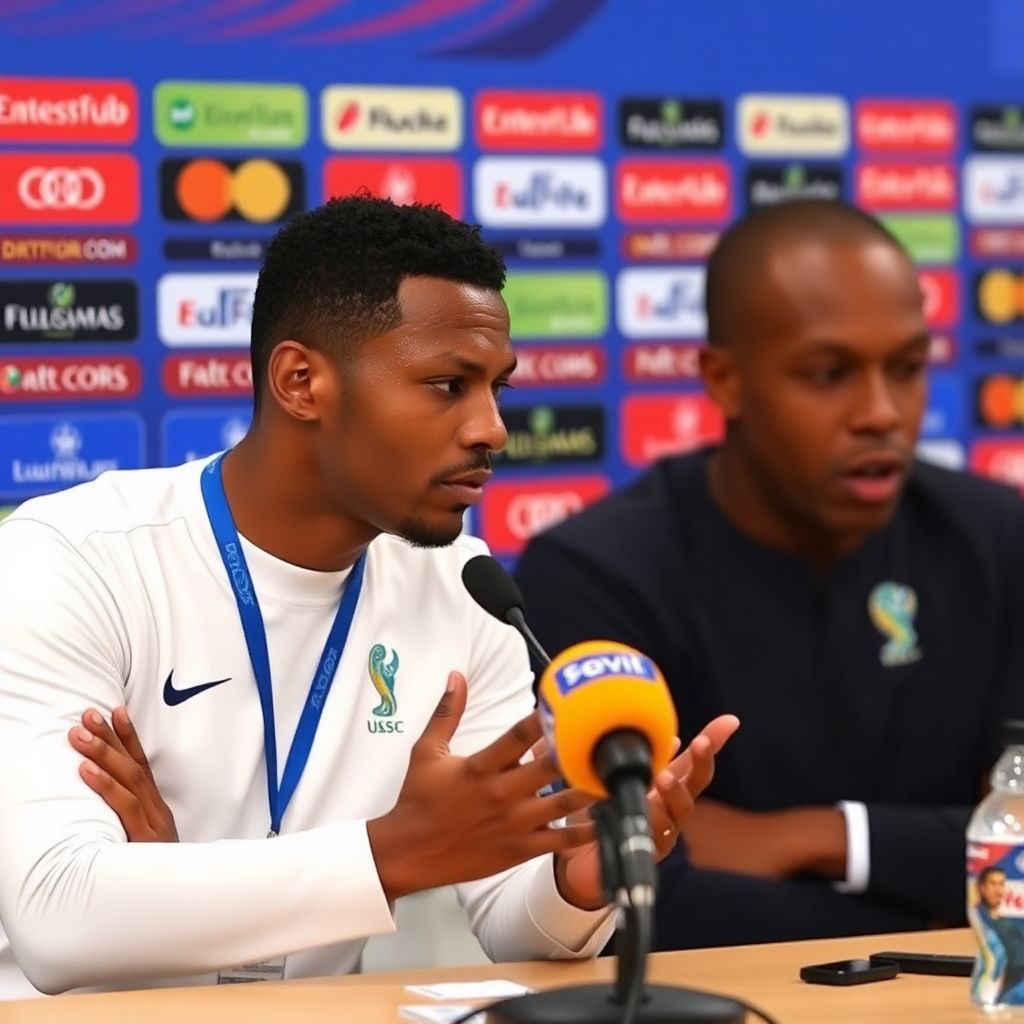
“Only an idiot would use Mbappe as a centre-forward? Then I must be one” – Deschamps fires back at criticism
France head coach Didier Deschamps has firmly defended both his tactical choices and Kylian Mbappe’s status in the national team setup as the 2026 World Cup approaches. Speaking about his captain’s role on and off the pitch, Deschamps made it clear that the decision to use Mbappe as a central striker is deliberate, thought-out and fully justified.
According to Deschamps, France’s current status as one of the leading contenders for the next World Cup is no accident.
“Calling us favourites is not a taboo word for me,” he stressed. “If we have that label today, it’s because of what we’ve done and the results we’ve achieved. It’s logical and deserved.”
The coach also acknowledged that the perception of his work differs between France and abroad. Domestically he is often criticised, especially for his pragmatic approach, while outside the country he is more widely respected.
“The perception abroad is very different,” he admitted. “If I’m still here today, it’s because of the matches this team has won. Otherwise my time in charge would have ended a long time ago.”
Deschamps has long been associated with a results-first mentality, and he did not shy away from that label. When asked about accusations that France are too defensive or not entertaining enough, he answered in his usual straightforward manner:
“It depends how you define playing style. Some people see us as a defensive team, but that hasn’t stopped us from being successful. For me, the most important thing is today and tomorrow. And tomorrow is the World Cup.”
Adaptation as the core of his coaching philosophy
Pressed on the secret behind his longevity and consistent success, Deschamps summed it up in a single word: adaptation.
“I adapt myself to the players in front of me,” he explained. “Just because something worked before doesn’t mean it will always work. But I don’t make changes just for the sake of changing either.”
This philosophy shapes not just his tactical setups but also how he manages personalities and generations within the squad. For Deschamps, understanding the individuals he works with – their strengths, needs and characters – is just as important as choosing a formation. Being able to shift from one game model to another, or from one leadership figure to the next, is what he sees as essential in modern international football.
A new generation and a new hierarchy
Deschamps also reflected on the evolution of the French national team since the 2022 World Cup final. That tournament effectively marked the end of an era: long-time pillars such as Hugo Lloris, Olivier Giroud, Raphael Varane and, in a different way, Antoine Griezmann have stepped out of the central spotlight. Their departures or reduced roles forced a natural change in leadership and communication inside the group.
With this generational shift, Deschamps believes the younger core needs more dialogue and constant interaction. Today’s players, often stars at their clubs from a very young age, expect transparency and feedback and are more inclined to question established hierarchies. The coach underlined that dealing with this new mindset requires more conversation, more explanation and more emotional intelligence from the staff.
Mbappe the captain: a different kind of leader
At the heart of this new France stands Kylian Mbappe. For Deschamps, the decision to hand him the armband was not merely symbolic but a logical extension of his influence.
“Kylian is our captain today,” he said. “Before taking on that role, he watched, he listened, he observed. He doesn’t have the same personality as Hugo, but he takes on leadership both on and off the pitch.”
Deschamps highlighted that when Mbappe speaks, he does so with the group in mind:
“When he talks, he knows he’s not speaking only for himself but for the whole team.”
This underlines a key point for the coach: Mbappe’s transformation from prodigious talent to leader. While Lloris used a calm, distant, almost understated form of authority, Mbappe’s leadership is more direct, emotional and visible. He interacts constantly, gestures a lot, pushes teammates and takes responsibility in decisive moments. Deschamps sees this as a new but equally valid form of captaincy, fitting the younger generation now dominating the squad.
“I must be an idiot for playing him as a centre-forward”
The most talked‑about part of Deschamps’ comments involved Mbappe’s position on the pitch. A recurring criticism is that Mbappe is less effective when used as a pure centre-forward rather than starting from the left. Deschamps answered those doubts with sharp irony:
“I must be an idiot for playing him as a centre-forward,” he said. “And I suppose all the other coaches who put him there must be idiots too.”
He then reminded everyone that this is not an experimental whim but a role Mbappe has been playing regularly at club level.
“In the last two years, he has played there at Real Madrid and at PSG. For three years now, he has been used as a centre-forward.”
By underlining this, Deschamps made clear that using Mbappe through the middle is a carefully reasoned decision, supported by the player’s recent career. In his eyes, Mbappe’s versatility is an asset: he can stretch defences from the wing, attack the space behind the back line as a nine, or drop to link play. The choice to position him centrally is about maximising his influence, putting him closer to goal and making him the reference point of the attack.
Why Deschamps insists on Mbappe in the middle
From a strictly tactical point of view, playing Mbappe at centre-forward offers several advantages for France:
– It places the team’s most decisive finisher in the most dangerous area of the pitch.
– It forces opposing defences to collapse centrally, opening space on the flanks for other attackers.
– It allows Deschamps to use more creative or hard‑working wide players around him, balancing the team.
– It gives Mbappe the freedom to drift to the left when needed, creating unpredictable movements.
Deschamps is aware that many fans and pundits love the version of Mbappe who tears down the left wing from deep positions. Yet he believes that, as Mbappe matures, his game naturally shifts towards areas closer to the goal – a classic evolution for many world‑class forwards. In that sense, the coach sees the central role not as a limitation, but as the logical next step in Mbappe’s career.
Balancing pragmatism and spectacle
One of the core tensions around Deschamps has always been the balance between winning and entertaining. His record speaks for itself: World Cup glory, another World Cup final, a European Championship final and constant presence in the latter stages of major tournaments. But the criticism about style persists.
Deschamps answers this by pointing to the demands of international tournaments, where there is little time to prepare and no room for lengthy tactical experiments. For him, efficiency, cohesion and the ability to suffer together matter more than possession percentages or spectacular passing sequences. He argues that his teams are capable of attacking football when the game requires it, but that their primary identity must be built on solidity and clarity of roles.
The psychological weight of being “favourites”
Labeling France as favourites for the 2026 World Cup is not only about quality; it also carries psychological pressure. Deschamps knows that other teams raise their game against France, and that his players are expected not just to win but to dominate.
By openly accepting the “favourites” tag as deserved, he removes any alibi or excuse. The message to his squad is simple: you are among the best, you have proved it, and with that comes responsibility. At the same time, Deschamps often reminds them that past success does not guarantee anything. Every cycle is different, and the new generation must build its own story rather than living off the memories of 2018 or 2022.
Managing egos and expectations in a star‑studded squad
Another less visible part of Deschamps’ job is handling the egos of elite players, many of whom are central figures in their clubs. With Mbappe as captain and main star, he has to maintain a delicate equilibrium: giving Mbappe the leadership he deserves without creating a sense of hierarchy that demotivates others.
His emphasis on adaptation comes into play here as well. Deschamps adjusts his communication to each player, knowing that a young emerging talent does not react in the same way as a veteran who has already seen everything. In this context, Mbappe is more than just a goalscorer; he becomes a relay between the coaching staff and the dressing room, someone who can translate messages and transmit the coach’s demands to his peers.
Mbappe’s central role in France’s 2026 World Cup plans
Everything in Deschamps’ discourse points to one conclusion: Mbappe will be the cornerstone of France’s project for the 2026 World Cup. As captain, leader and primary attacking weapon, he is expected to carry an even greater load than in previous tournaments.
By defending both his choice of captain and his tactical use of him with such conviction – even with a touch of sarcasm – Deschamps is sending a clear message to critics: the plan is set, the roles are defined, and Mbappe as a centre-forward is not up for debate.
For the coach, the equation is simple. Adaptation, clarity and trust in his key players have brought France to the top of world football. With Mbappe at the heart of his system, he intends to keep them there.