World Cup dream in danger: heavy suspension looming over Neymar
Neymar’s hopes of making it back to the biggest stage of international football have been thrown into serious doubt, with the Brazilian star facing a potentially lengthy ban that could run up to 10 matches. The disciplinary storm erupted after the forward allegedly directed discriminatory language at a referee during a match in Brazil.
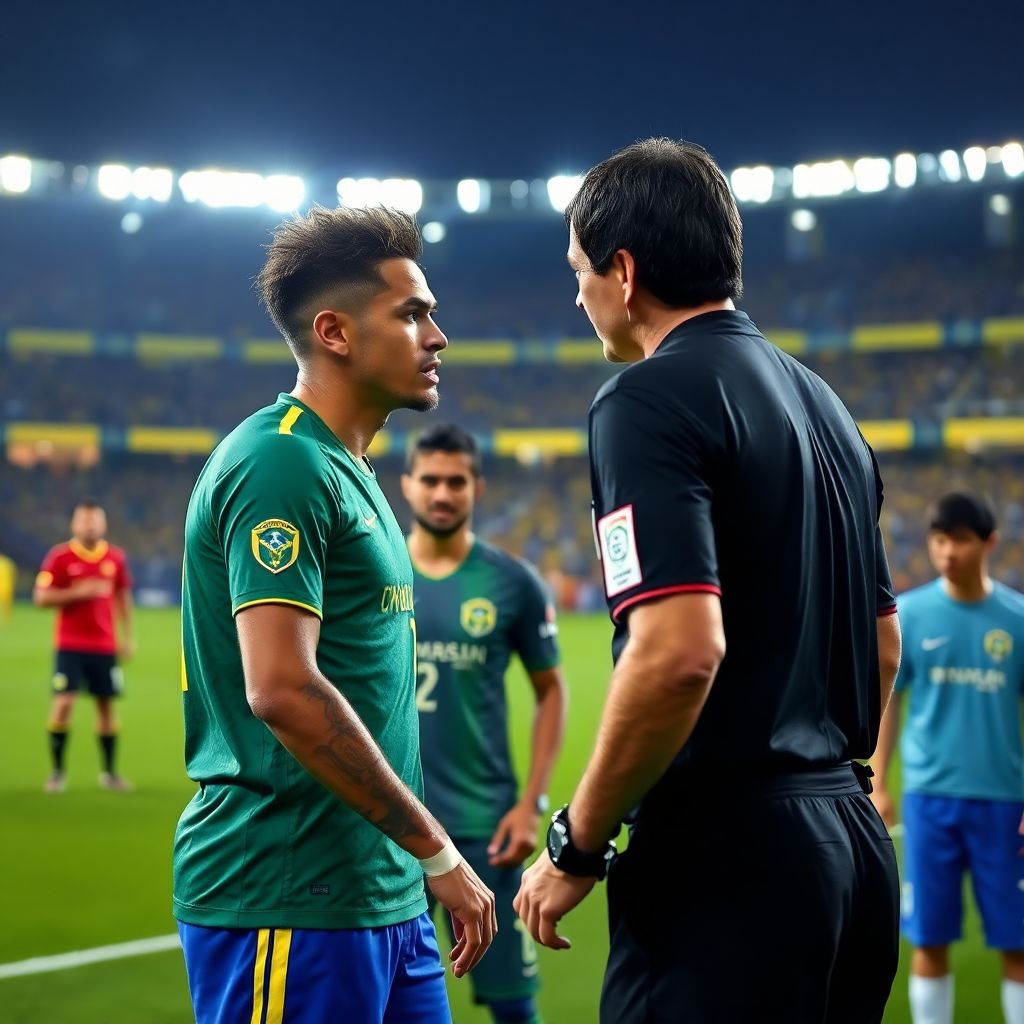
The incident occurred in a domestic fixture where Neymar, currently playing for Santos, is reported to have confronted match official Savio Pereira Sampaio after the final whistle. According to reports, the referee was subjected to a discriminatory remark, an accusation that has immediately drawn the attention of the sporting judiciary in Brazil.
Under the Brazilian Sports Justice Code, conduct deemed “discriminatory or degrading” can lead to severe punishment. Neymar’s case is expected to be examined under this specific article, which is designed to tackle racism, xenophobia, homophobia and other forms of prejudice in sport. If the allegation is confirmed and the strictest interpretation is applied, the forward could be suspended for anywhere between 5 and 10 matches.
There is also a possibility that the incident may be evaluated under a different, less severe provision of the regulations. In that scenario, the range of punishment would likely be reduced to a ban of 1 to 6 games. Even this lighter option, however, would still have tangible sporting consequences for the player at a delicate moment in his career.
The timing of the potential suspension could hardly be worse. The Brazilian league is approaching a key stretch before an upcoming break, with only a limited number of matches left for players to prove themselves. Any multi-game ban would significantly cut into Neymar’s opportunities to regain rhythm, demonstrate his physical readiness, and showcase his current level to the national team staff.
At 34, Neymar is no longer the young prodigy who burst onto the scene over a decade ago. His objective now is clear and sharply defined: fight his way back into the Brazil national team set-up and secure a place in the squad for the 2026 World Cup under head coach Carlo Ancelotti. That ambition already faces stiff competition from in-form, younger attacking talents; an extended absence due to suspension would only make that challenge steeper.
Ancelotti has been frank in previous statements, stressing that Neymar is not yet at one hundred percent physically. The coach tied earlier decisions to leave him out of the national team squad directly to concerns over his fitness and lack of consistent game time. For an experienced player trying to convince a demanding manager, every match counts – and a ban would mean losing precious windows to prove long-term reliability.
For Neymar, the situation goes beyond a simple disciplinary issue. At this stage of his career, rhythm, continuity and image are all intertwined. He needs regular minutes to regain match sharpness after repeated injury setbacks, but he also needs to show that he can avoid controversy on and off the pitch. Any stain on his disciplinary record, especially one linked to discriminatory language, risks damaging his reputation at a moment when he is trying to build a compelling case for selection based on professionalism as much as talent.
This potential punishment must also be viewed in the broader context of how football is handling discrimination. Across the global game, governing bodies have been pushing for tougher sanctions when it comes to offensive, racist or discriminatory behavior involving players, staff or fans. The Brazilian authorities, in line with this trend, are under growing pressure to apply the rules rigorously, particularly when star names are involved, to send a strong message that no one is above the law.
If the allegations against Neymar are upheld, the disciplinary commission will face a delicate balancing act: weighing the gravity of the words used, the intention behind them, and the player’s previous record. A lengthy suspension might be seen as an important precedent in the fight against discriminatory behavior, while a lighter sentence could attract criticism for perceived leniency toward a high-profile figure.
From a sporting perspective, the potential absence also affects Santos. The club relies on Neymar’s experience, technical quality and star power, both on the pitch and commercially. Losing him for several matches would force the coaching staff to modify tactical plans and could impact the team’s performance and league position. For younger players in the squad, it may open a short-term opportunity for increased responsibility, but for the club’s ambitions this is far from ideal.
Psychologically, this episode could become another test of Neymar’s resilience. Throughout his career, he has often found himself at the center of controversy, whether due to injuries, transfer sagas or disciplinary debates. How he reacts now – in terms of public response, conduct before the disciplinary bodies, and performances if and when he returns – may play a decisive role in shaping the final chapters of his international career.
Looking ahead to the 2026 World Cup, the criteria for selection in a team like Brazil go far beyond technical ability. The national team staff will consider physical condition, recent performances, adaptability to tactical schemes, and dressing-room influence. A player under the spotlight for negative reasons risks slipping down the pecking order, especially when competition for attacking spots includes rising stars eager to seize their chance.
To keep his World Cup dream alive, Neymar will likely need three things: a manageable sanction, an extended stretch of injury-free football, and a clear shift in narrative from controversy to contribution. That means turning the conversation from disciplinary risk to decisive goals, smart playmaking, and leadership on the field for both club and country.
Should he avoid the harshest penalty and return swiftly to action, there is still enough time for him to rebuild trust. Strong, consistent displays in the Brazilian league could calm doubts about his physical state and show Ancelotti that he can still be relied upon at the highest level. Conversely, a long ban followed by further interruptions would make it increasingly difficult to justify his inclusion in a squad that must be built with intensity, continuity and future planning in mind.
In the end, this case may become a defining moment in Neymar’s late career. Either it serves as a turning point that pushes him to stricter discipline, stronger focus and renewed commitment, or it becomes another setback that accelerates his decline from the very top of the international scene. For now, all eyes are on the disciplinary authorities and the verdict that could shape not only his immediate future with Santos, but also his last big shot at World Cup glory.