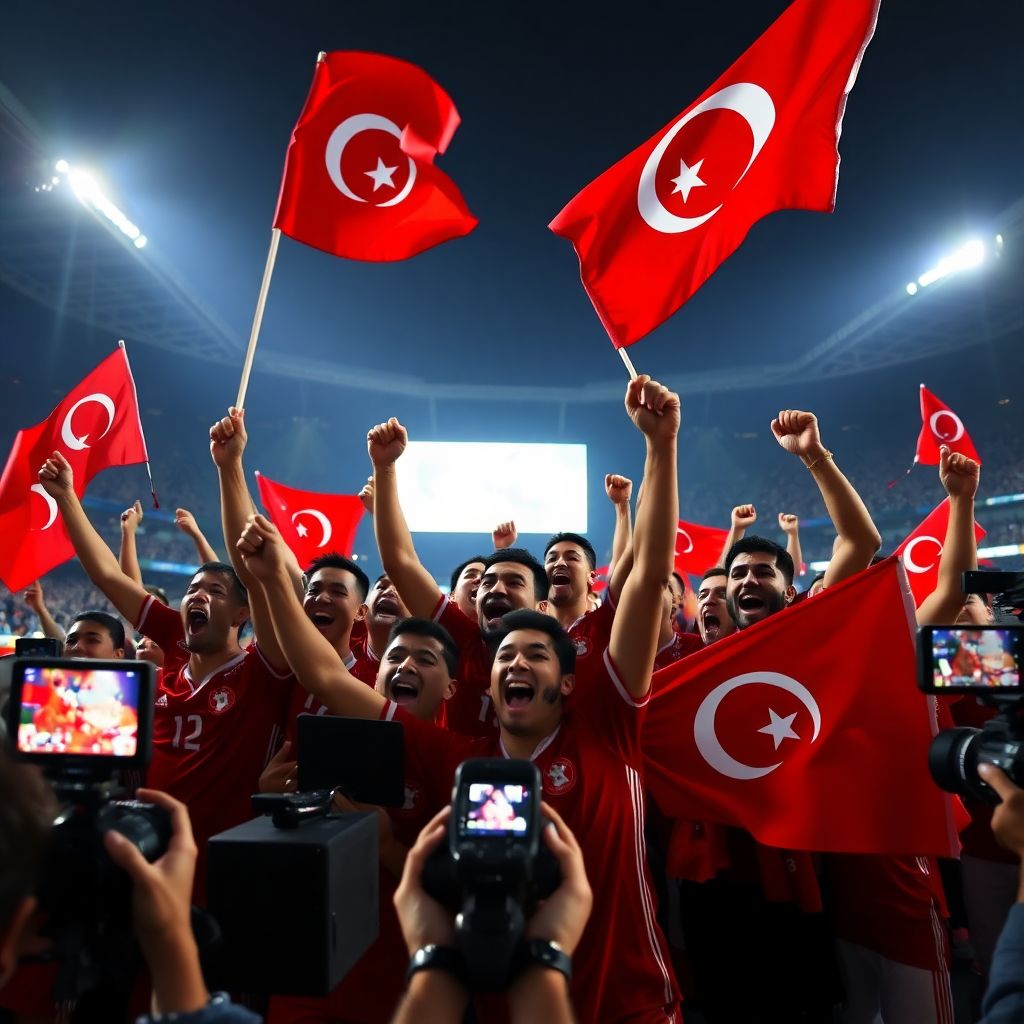
Ay-Yıldız return to the world stage: Turkish national team in global spotlight
The Turkish national team’s 1-0 victory over Kosovo in the play-off final, securing a place at the 2026 World Cup, has made headlines across the international media. After a 24-year absence from football’s biggest stage, the “Crescent-Stars” have not only booked their ticket to the tournament but also reignited global interest in Turkish football.
Playing away in Pristina, Türkiye clinched qualification thanks to a decisive goal from Kerem Aktürkoğlu. That single strike was enough to send the team back to the World Cup for the first time since 2002, a year etched in memory for the historic semi-final run. Now, with their place confirmed in Group D, the national side has become one of the most talked-about teams of the qualifiers.
International media react to Türkiye’s historic night
The qualification story quickly traveled beyond Türkiye’s borders, with leading sports outlets highlighting both the emotional weight of the achievement and its impact on other nations.
The Athletic focused on the group-stage implications, underlining that Türkiye’s arrival in Group D complicates the path for the United States. According to their analysis, with Türkiye claiming the final spot in the group, the American team’s route to the knockout stages has become significantly more challenging than many of their supporters had anticipated.
Spanish daily AS devoted special attention to the new face of Turkish football, Arda Güler. Describing him as “a legend in the making,” the outlet emphasized that Türkiye’s 1-0 win in Pristina not only sealed World Cup qualification after 24 years, but also showcased a generational talent destined to shape the team’s future.
Another Spanish giant, Marca, noted that Türkiye and Arda Güler experienced some tense moments in the closing stages against Kosovo, yet managed to hold on and confirm their return to the World Cup after more than two decades. The paper highlighted both the resilience of the team and the creative influence of its young star.
From the United States, ESPN framed the story around the play-off drama, stating that Türkiye’s victory in the final has set up a high-profile World Cup clash with the US. In their coverage, the emphasis was on how Türkiye’s disciplined display and decisive finishing transformed them from play-off hopefuls into one of the most intriguing opponents in the American group.
In Italy, La Gazzetta dello Sport singled out head coach Vincenzo Montella, stressing that Kerem Aktürkoğlu’s lone goal was all Türkiye needed, and that the happiest Italian of the night was undoubtedly the man on the Turkish bench. For Gazzetta, Montella’s success in guiding Türkiye to the World Cup was portrayed as a personal triumph, symbolizing a coach who has reinvented himself on the international stage.
Agency reports also underlined the drought-breaking nature of the result. Reuters highlighted that Türkiye’s win over Kosovo finally ended a 24-year World Cup absence, framing it as the closure of a long and frustrating chapter. German outlet Sport Bild echoed this sentiment, writing that after their last appearance 24 years ago, Türkiye has now officially secured a new ticket to the tournament.
In the Middle East, Al Jazeera stressed the scale of the comeback: beating Kosovo 1-0 in the play-off final ended a 24-year wait and brought Türkiye back to the grandest arena of world football for the first time since 2002. British tabloid Daily Star used similar language, noting that the narrow victory in the final put an end to “a 24-year wait” and sent Türkiye back to the World Cup finals.
BBC Sport underlined the dramatic nature of the match, observing that Türkiye, led to victory by Kerem Aktürkoğlu’s goal, had to “work hard” to overcome Kosovo, but in doing so sealed their return to the World Cup after nearly a quarter of a century.
The end of a 24-year World Cup exile
The qualification carries heavy historical symbolism. Türkiye’s last World Cup appearance, in 2002, produced one of the country’s greatest sporting stories, as the team surged to the semi-finals and ultimately finished third. Since then, missed tournaments and unfulfilled promise have weighed on successive generations.
Breaking a 24-year dry spell is more than a statistical milestone. It marks a psychological turning point for the national team and its supporters. For a football culture that lives and breathes the game, not being present on its biggest stage had become a recurring trauma. This qualification restores a sense of belonging among the world’s elite and signals that Turkish football can again set ambitious targets rather than simply dream of participation.
Montella’s blueprint: discipline, balance and belief
A central figure in this revival is head coach Vincenzo Montella. The Italian manager has steadily reshaped the team’s identity, balancing traditional Turkish attacking flair with greater tactical discipline. The controlled, patient performance against Kosovo, where Türkiye managed the tempo and minimized risk in key phases, reflected that transformation.
Montella has placed emphasis on compact defending, fluid transitions, and intelligent use of his technically gifted attackers. Instead of relying solely on individual brilliance, the current side functions as a cohesive unit, with structure off the ball and creativity on it. International coverage has repeatedly highlighted how Montella’s pragmatic yet modern approach has turned Türkiye into a dangerous and unpredictable opponent for established powers.
New generation, new expectations
Beyond the coaching, a new generation of players is redefining the image of the national team. Arda Güler, widely praised in Spanish and European media, has become a symbol of this emerging era. His vision, touch, and composure under pressure suggest a player capable of influencing matches at the highest level.
Alongside him, Kerem Aktürkoğlu has emerged as a decisive figure. His winning goal against Kosovo will likely be remembered as a defining moment of this campaign. Quick, fearless, and efficient in the final third, Kerem gives Türkiye a direct threat that worries any defense. Together, Arda and Kerem represent a blend of creativity and efficiency that can tilt tight games in Türkiye’s favor.
Around these stars, a core of experienced professionals and versatile younger talents is forming a balanced squad: defenders more comfortable playing out from the back, midfielders who can press and build, and forwards willing to defend from the front. This mix of energy and maturity has been central to the qualification push and will be essential in Group D.
Group D: a demanding but open battlefield
With Türkiye confirmed in Group D, analysts worldwide are already dissecting their prospects. The presence of the United States, combined with other strong contenders in the group, creates a demanding environment where small details will separate success from failure.
The Athletic’s assessment that the US now face a tougher route is a recognition of Türkiye’s rising profile. Tactically, Türkiye’s versatility poses problems: they can press high and play aggressively, or sit deeper and strike on the counter through quick wingers and midfield runners. For opponents, this means preparing for multiple game plans and in-game adjustments.
The group is unlikely to have clear favorites in every match, which opens the door for Türkiye to aim higher than mere participation. Reaching the knockout stages is now a realistic objective, especially if the team carries the belief and cohesion shown in the play-offs into the tournament itself.
Tactical strengths and remaining weaknesses
The play-off final highlighted some of Türkiye’s strongest traits: composure under pressure, defensive organization, and the ability to exploit limited chances. Montella’s side kept their shape, avoided reckless mistakes, and capitalized on a key opportunity through Kerem.
However, several outlets also pointed to periods of instability in the closing stages. Marca, for instance, referenced how Türkiye had to “suffer” in the final minutes. This underlines an ongoing challenge: learning to close games with greater authority and reducing unnecessary tension late in matches.
For the World Cup, enhancing game management will be crucial. Against top-tier opponents, a single lapse can undo 89 minutes of good work. Improving set-piece defending, maintaining concentration when protecting narrow leads, and rotating intelligently to preserve energy will be decisive factors in turning competitive performances into actual results.
Emotional impact on the country
Inside Türkiye, the qualification has triggered a wave of emotion that transcends sport. For many fans, memories of 2002-pre-dawn kick-offs, crowded streets, and celebrations after every victory-remain vivid. The return to the World Cup promises to revive that atmosphere for a new generation who have only heard stories of those days.
The current team carries both the weight and the inspiration of that legacy. Younger players grew up watching highlights of the 2002 squad’s achievements. Now, they have the opportunity to create their own story, not as heirs living in the shadow of the past, but as protagonists of a new chapter. The global attention they are receiving reinforces that their journey is being watched far beyond the country’s borders.
Türkiye’s global image through football
Qualification also plays a role in how Türkiye is perceived internationally. Football is one of the most visible forms of soft power, and presence at the World Cup offers a platform to showcase the country’s culture, passion, and competitive spirit. Every match at the tournament becomes a form of global representation, from the anthem on the pitch to the fans in the stands.
The fact that so many international outlets have highlighted Türkiye’s story-its long absence, its new stars, its Italian coach-shows that the team has become a narrative draw in its own right. Neutral fans often gravitate towards teams with compelling backstories, and Türkiye’s combination of history, drama, and youthful talent makes them one of the intriguing sides to follow in Group D.
Looking ahead: from qualification to ambition
Securing a World Cup spot was the immediate objective; now the challenge is to transform that success into a platform for sustained progress. The coaching staff will use the remaining months to refine tactics, deepen squad depth, and test different line-ups in high-level friendlies. Building chemistry between key players like Arda Güler and Kerem Aktürkoğlu, while stabilizing the defensive core, will be at the forefront of preparation.
Expectations will inevitably rise, but the team’s internal focus is likely to remain pragmatic: first, survive the group; then, see how far they can go, match by match. The memory of 2002 serves as both an inspiration and a reminder that breakthroughs are possible when a talented squad hits form at the right moment.
A new chapter for the “Crescent-Stars”
From Pristina to the world’s front pages, Türkiye’s 1-0 win over Kosovo has resonated far beyond the final whistle. The victory ended a 24-year World Cup drought, thrust the national team back under the global spotlight, and introduced a new generation of Turkish players to an international audience.
With Montella on the touchline, Arda Güler orchestrating in midfield, and Kerem Aktürkoğlu proving decisive in front of goal, Türkiye heads into Group D not as a mere participant, but as a team capable of altering the balance of power. The world is watching-and this time, the “Crescent-Stars” will be there when the biggest show in football begins.