The tactical evolution of the Turkish national football team over the last three decades moves from compact, reactive defending in the early 1990s, through manager-driven structural shifts in the 2000s, to modern high-press and possession concepts in the 2010s, offering a practical blueprint for coaches adapting limited, mixed-quality squads.
Strategic Summary: Three-Decade Tactical Arc of Turkey
- Turkey national football team history shows a clear move from deep blocks and direct attacks to more proactive, pressing-based systems.
- Manager personalities strongly shaped structures, with each cycle tied to a distinct formation family and risk profile.
- Turkey football team evolution over the years mirrors club trends: zonal defending, line-breaking passes, flexible front lines.
- Turkey national team performance by year is less consistent than its tactical ideas, highlighting the importance of squad fit and role clarity.
- Major tournaments served as tactical laboratories; Turkey national team major tournaments record reflects both overperformance and underuse of available talent.
- For coaches, systematic Turkey national team tactics analysis helps model transitions from reactive to proactive football without losing defensive stability.
Foundations: Tactical Identity in the Early 1990s
Who this model suits
- National or club teams with limited technical quality but strong mentality and work-rate.
- Squads with physically robust centre-backs and a target forward capable of holding long balls.
- Leagues or environments where pitches, refereeing and tempo naturally favour direct football.
When you should avoid copying this period
- When you have many creative midfielders who need ball circulation to influence the game.
- If your defenders lack pace; a deep block without pressure on the ball invites long shots and second balls.
- When federation or club strategy explicitly demands dominant possession and short build-up.
Core objectives of the early-1990s Turkish identity
- Compactness in own half; minimal space between lines.
- Vertical, low-risk passing into channels and target man.
- Strong emphasis on duels, second balls and set pieces.
Key actions to model this phase
- Defensive line trained to move as a unit, prioritising depth over width.
- Midfielders coached to screen central zones, not chase wide areas.
- Early crossing and diagonal balls rehearsed as primary attacking patterns.
Simple coaching applications
- Introduce weekly “compactness games” on a shortened pitch to reinforce distances between lines.
- Allocate fixed time to long-ball and second-ball scenarios in every session to simulate period-style play.
Manager-Led Revolutions: Systemic Changes in the 2000s
What you need in place before shifting systems
- Stable leadership: a head coach with clear non-negotiables and alignment with federation or club board.
- Video and data access: at least simple match footage and basic event data to track tactical trends.
- Fitness base: players capable of repeated high-intensity efforts to support pressing and transitions.
- Role clarity tools: laminated role cards, video clips, or simple diagrams for each position group.
- Time windows: clearly planned micro-cycles around international breaks to introduce new mechanisms safely.
Core requirements by system family (typical 2000s Turkey shifts)
| Era / Approach | Typical Formation | Press Intensity | Main Build-Up Pattern | Representative Key Profiles |
|---|---|---|---|---|
| Early 1990s Base | 4-4-2, 4-5-1 | Low-medium, situational | Direct to target man, second balls | Physical CBs, target FW, hard-working wide players |
| 2000s Transitional | 4-2-3-1, flexible 4-3-3 | Medium-high, ball-oriented | Full-backs higher, 10 linking midfield and attack | Creative 10, box-to-box 8, attacking FBs |
| 2010s Modern | 4-1-4-1, 4-3-3, 4-4-2 diamond | High, trigger-based press | Short build-up, third-man runs | Mobile 6, inverted wingers, pressing forwards |
Practical tools to manage revolutions
- A “tactical evolution roadmap” across 18-24 months, not one big overnight change.
- Simple pre- and post-match surveys asking players which patterns feel clear or confusing.
- Quarterly review workshops using key clips from Turkey national football team history to illustrate chosen direction.
Actionable coaching steps
- Define three non-negotiable team principles (for example: compactness, forward runs, counter-press) and keep them constant across formation tweaks.
- Run monthly scenario sessions where you deliberately switch between “old” and “new” shapes to speed up squad adaptability.
High-Press and Possession: The 2010s Modernization
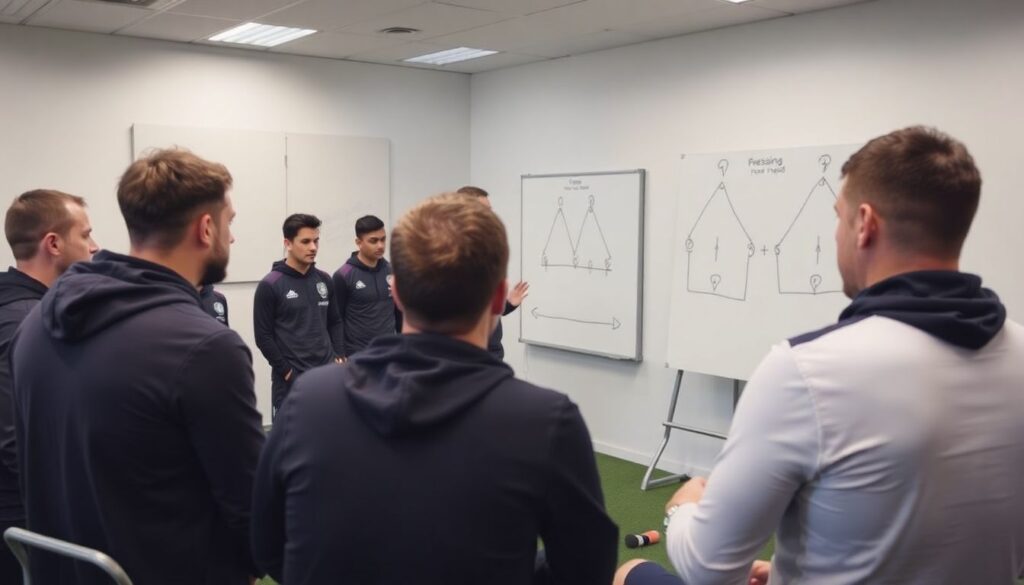
Pre-session preparation checklist
- Clarify your pressing height (high, mid, or hybrid) based on opponent build-up quality.
- Select two core build-up patterns (for example, 3+1 base or 2+1 base) and stick to them for at least four games.
- Define roles of your 6, 8s, and wingers in counter-pressing before introducing complex rotations.
- Collect 5-10 video clips from Turkish games in the 2010s showing pressing traps and third-man combinations.
- Align physical periodisation so that high-intensity pressing days precede lower-load tactical days.
-
Anchor the positional structure
Start from your preferred base shape (4-3-3, 4-1-4-1 or similar) and mark zones on the pitch to create visual anchors. Ensure players understand their “home zone” and “support zone” in possession and out of possession.- Use cones or flat markers to draw lanes and half-spaces.
- Freeze play in training whenever players overload the same line.
-
Design clear pressing triggers
Decide on 2-3 simple triggers, like a back-pass, poor first touch, or sideways pass to full-back. Link each trigger to a pre-defined pressing pattern rather than relying on improvisation.- Rehearse each trigger in isolated 6v6 or 7v7 games.
- Track how often players recognise and react to triggers in friendly matches.
-
Build short-passing escape routes
To mirror the best moments of Turkey football team evolution over the years, create automatic exit patterns from pressure, such as third-man runs or bounce passes into midfield.- Run rondo-based drills that always end in a vertical pass through the lines.
- Assign one midfielder as the “pressure outlet” responsible for angles.
-
Integrate counter-pressing after loss
As soon as possession is lost, the closest three to five players must react together. Train “5-second rules” where the objective is to recover or at least delay within a small time window.- Combine finishing drills with immediate defensive transition tasks.
- Time counter-pressing sprints to match match-intensity demands.
-
Synchronise midfield and back line
Only push your defensive line higher when midfield is stable. Use simple verbal cues and pre-agreed movements to prevent gaps between lines when pressing.- Alternate waves of pressure so your 6 is never isolated.
- Review conceded chances specifically for spacing errors.
-
Embed role-based video feedback
Use short, role-specific video clips to show each unit (defence, midfield, attack) how they contributed to pressing and possession sequences.- Limit clips to 10-15 minutes per meeting to avoid overload.
- Highlight one behaviour to reinforce and one to correct per player.
Coaching implementation notes
- Introduce high-press days gradually, starting with short blocks of intense games before stretching duration.
- Regularly compare your patterns to recent Turkey national team tactics analysis to keep methods aligned with current best practice.
Tournament Case Studies: Euro 2008 and Euro 2020/2021 Analyses
Performance and process evaluation checklist
- Compare Turkey national football team performance by year around Euro 2008 and Euro 2020/2021 to understand whether peaks were sustainable or one-off.
- Check if tactical identity stayed stable across group and knockout games, or if reactive switches caused confusion.
- Analyse goal timings to see whether the game model supports late comebacks or early control.
- Review substitutions by minute: do they reinforce the plan or change the system entirely mid-game?
- Assess relationship between possession percentage and chance quality, not just shot volume.
- Use clips to judge pressing cohesion: do front, midfield and back lines jump together?
- Track set-piece organisation; tournaments often expose poor rest-defence structure during own corners.
- Compare tournament games with qualifiers to identify which behaviours survived increased pressure.
- Relate findings to Turkey national team major tournaments record to set realistic benchmarks for your own team.
Coaching applications from these tournaments
- Design pressure-phase friendlies that simulate tournament intensity, including short turnarounds and travel fatigue.
- Establish a “tournament core” of principles you never change, even when scorelines push you towards panic decisions.
Player Archetypes and Role Evolution: From Target Men to Mobile Forwards
Common mistakes when copying Turkish role evolution
- Expecting traditional target forwards to press like modern mobile 9s without adjusting training and fitness plans.
- Converting wingers into inside forwards without giving full-backs the licence and support to provide width.
- Dropping a creative 10 deeper as an 8 without teaching defensive body orientation and pressing angles.
- Assuming ball-playing centre-backs remove the need for a tactically intelligent 6 during build-up.
- Overloading one flank with playmakers, leaving the far side empty and easy to defend.
- Ignoring aerial presence altogether when moving away from classic target men, losing a simple out ball.
- Recruiting names instead of profiles; chasing famous attackers who do not match the running demands of your model.
- Underusing data and video to profile players, leading to role confusion and poor squad balance.
- Forgetting transitional qualities; focusing only on technical skills and not on how players behave immediately after loss or gain.
Actionable steps on role design
- Create written “archetype cards” for each line (for example, mobile 9, inverted winger, playmaking 6) with 3-5 key behaviours.
- Run positional games where each player must stay within the behaviours of their archetype to reinforce identity.
Practical Implementation: Training, Analytics, and Scouting for Tactical Change
Alternative implementation routes
-
Gradual evolution route
Maintain your current base shape but progressively change behaviours: pressing triggers, build-up patterns, and transitions. This route suits teams with limited training time, such as national squads, and fits the incremental story told by Turkey national football team history. -
System reboot route
Introduce a clearly different formation and style in pre-season or a long camp. Use intensive education blocks, friendly matches, and clear KPIs. This works when results have plateaued and you need a visible break with the past. -
Hybrid and opponent-specific route
Keep two compatible systems (for example, 4-3-3 and 4-2-3-1) and choose based on opposition strengths. This demands tactically intelligent players and robust video support but can maximise flexibility in key fixtures. -
Youth-to-senior alignment route
Start the tactical evolution in youth teams, then promote players who already understand the game model. This option has slower short-term impact but creates long-term structural stability.
Training, analytics, and scouting integration tips
- Align scouting profiles to your chosen route so new signings accelerate, not delay, tactical change.
- Use simple, repeatable metrics (runs behind, counter-press recoveries, line-breaking passes) to evaluate progress, not just scorelines.
- Benchmark your trends against Turkey national team performance by year to understand what realistic improvement looks like across cycles.
Coaching implementations to start now
- Run a staff workshop mapping your current team onto the three-decade Turkish evolution table and decide which era you most resemble today.
- Set a 6-12 month tactical goal (for example, “hybrid high-press and possession”) and link every training block to that direction.
Practical Questions on Applying Turkish Tactical Lessons
How can I adapt Turkey’s high-pressing ideas if my team has low fitness levels?
Use a mid-block instead of a constant high press and apply pressing only on clear triggers. Shorten the duration of high-intensity games in training and focus on coordinated jumps rather than constant sprints.
What is the safest way to move from a direct style to more possession-based play?
Begin by improving build-up in your own half while keeping direct options to the forward. Add one new passing pattern at a time and avoid changing formation and roles simultaneously.
How closely should a youth coach follow the tactical models of the Turkish national team?
Use national-team patterns as inspiration, not strict rules. Prioritise teaching fundamentals such as spacing, pressing triggers, and role flexibility, then reference Turkish examples to give players context.
Can small clubs realistically copy the tactical evolution of a national team?
They can copy principles and training methods, but must adapt complexity to their training time and player quality. Focus on 2-3 core behaviours rather than the full national-team playbook.
How do I measure if my tactical evolution is actually working?
Track clear indicators like chances created, chances conceded, pressing success, and progression through thirds. Compare trends across 5-10 matches instead of judging single results.
Is it risky to change formations just before a major tournament or play-off?
Yes, formation changes late in a cycle can create confusion. If necessary, make only small adjustments within the same structure and reinforce your main principles instead of introducing a new system.
What role does data play compared with live observation for these tactical changes?
Data helps you see patterns over time, while observation explains the “why”. Combine both: use data to identify issues and video or live viewing to design specific solutions.