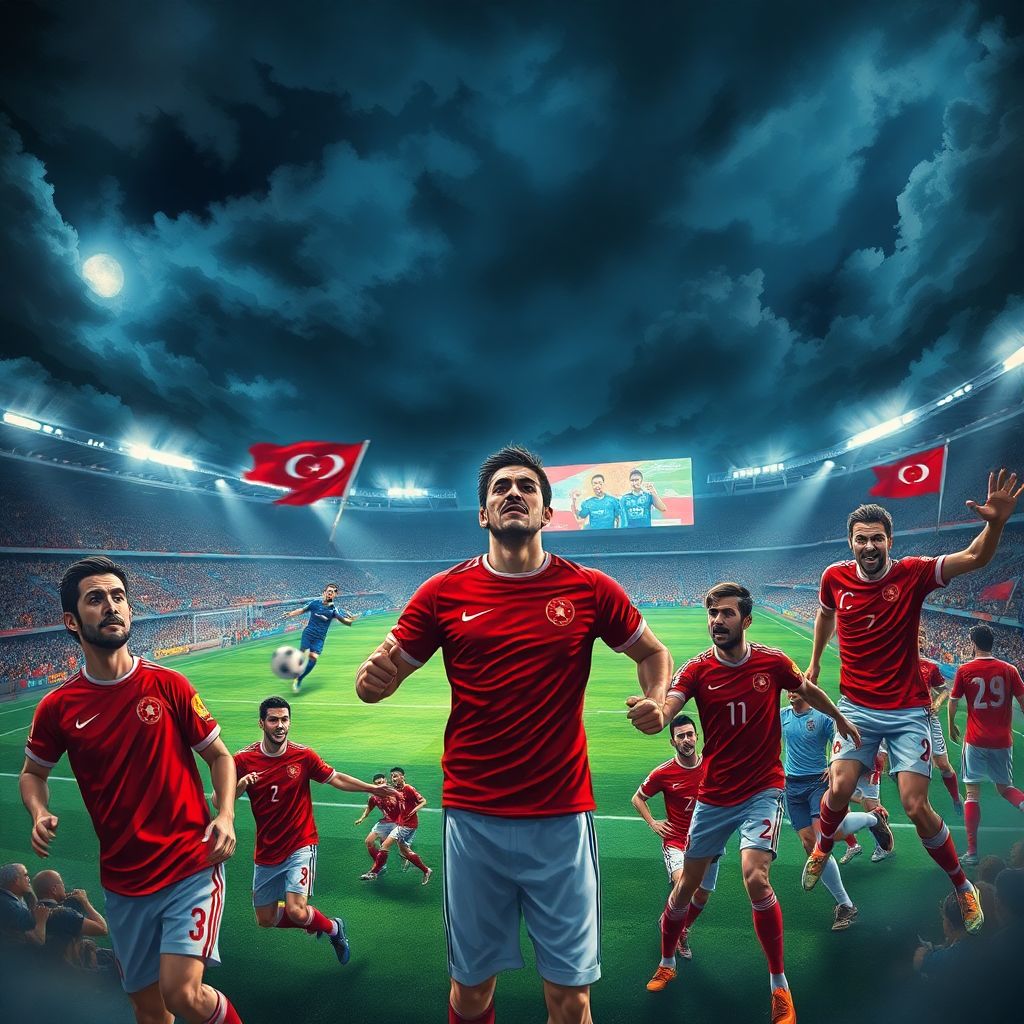
From Dark Horses to Global Storytellers
When people talk about iconic moments in football, the Turkish national team often comes as a surprise entry, yet their history is full of sharp plot twists. Think of a side that wasn’t always at крупных турнирах, but every time it broke through, it left a mark. The journey from nearly anonymous qualifiers to semi‑finals of the World Cup and Euros is not just about tactics or lucky bounces; it’s about how a football culture learned to embrace chaos, turn late drama into a habit and convert emotional energy of the stands into a competitive edge on the pitch.
The 2002 World Cup is the clearest turning point. Before that summer, few outside Turkey could name more than a couple of players. By the end of the tournament, the entire squad had become household names. The team navigated a brutal group with Brazil, then powered past co‑hosts Japan and South Korea to reach third place. This wasn’t a fluke cup run; it was the product of a generation that had grown up together in domestic clubs, absorbed European tactical trends and still played with the improvisation typical of Turkish street football. The mix of discipline and spontaneity is what made those games so memorable — and so instructive for modern player development.
Iconic Matches That Forged Identity
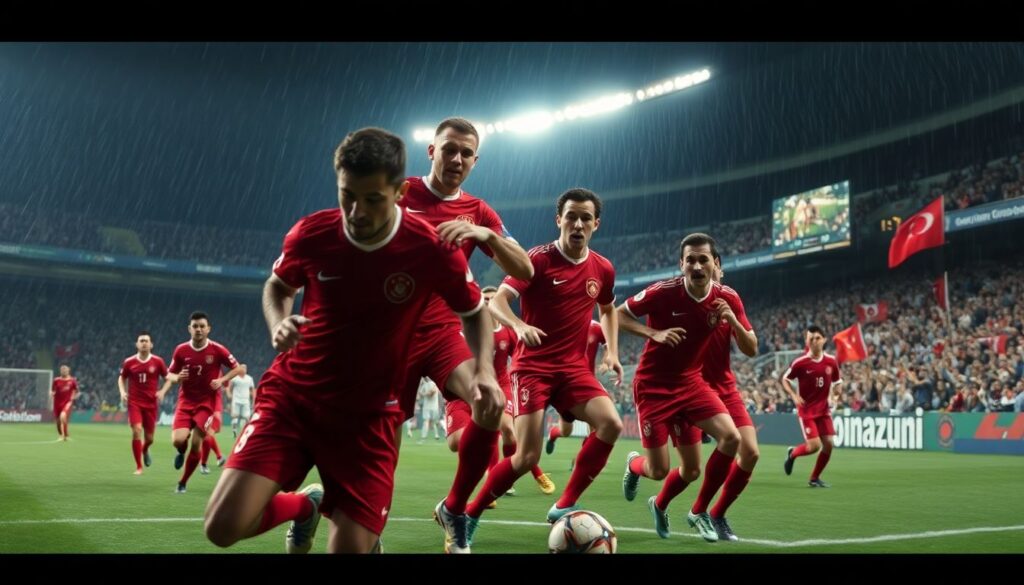
If you want to understand the psychology of the Turkish national team, rewatch the final minutes of their most famous comebacks. Euro 2008 turned “never give up” from a slogan into a measurable pattern. Against Switzerland, the team overturned a deficit in driving rain. Against the Czech Republic, they scored three goals in the last 15 minutes, including a 92nd‑minute winner. Then came Croatia in the quarter‑finals: equaliser in the 120th minute, victory on penalties. These games shaped an identity: Turkey might not dominate from minute 1 to 90, but they will drag you into emotional time, where resilience counts more than clean passing maps.
Behind those eruptions of drama stood clear structures. Fatih Terim and his staff tailored a game plan that accepted temporary suffering: absorb pressure, keep the game alive, then increase risk dramatically in the final stages. Analитически это выглядело как управляемый хаос: substitution patterns were geared to inject pace and aerial power late on, pressing triggers were saved for the last quarter of the match, and the team relied heavily on mental conditioning — players spoke later about training sessions that simulated “being behind” and forced them to respond under time pressure.
A less‑discussed but crucial moment came earlier, in the Euro 2000 and 2002 World Cup qualification cycles. Turkey learned to handle pressure games away from home, including decisive results against Germany and Ukraine, where the team proved it could be structurally solid instead of only emotional. These experiences formed the backbone of a new generation. By the time the world saw that famous turkey national team retro jersey 2002 world cup design flying across Asian stadiums, the mental foundation had already been laid in much emptier arenas during qualifying nights.
Inspiring Examples: Players Who Redefined Possibility
Iconic moments are always attached to personalities, and the Turkish national team has produced several symbolic figures whose careers double as case studies. Rüştü Reçber, for example, showed what happens when a goalkeeper becomes a psychological pillar. Beyond his saves in 2002, he represented a new professionalism: meticulous pre‑match routines, video analysis before it became mainstream, and an obsessive attention to communication with the back line. Young goalkeepers in Turkey started copying not only his face paint, but his habit of studying opponents’ body language on penalties.
Another emblematic figure is Hakan Şükür, the striker who needed only 11 seconds to score against South Korea in the 2002 third‑place match. That goal is typically remembered as a record, but it also reflects years of automated movement patterns: Şükür’s run, the timing of the press, the immediate vertical pass. Coaches later revealed they had spent entire sessions on “first 15 seconds” scenarios — kick‑off routines designed to shock the opponent before their shape settled. The lesson is clear: what looks like spontaneous brilliance usually rests on repetitive, unglamorous drills.
More recently, the rise of players like Arda Turan and later Hakan Çalhanoğlu and Çağlar Söyüncü has created new types of inspiration. Their paths through European clubs provided real‑life evidence for academy kids that a Turkish player could become a tactical leader in La Liga, Serie A or the Premier League. The symbolic impact is tangible: academies report more midfielders wanting to specialise in set‑piece delivery, pressing intelligence and build‑up play, instead of only dreaming of being the next superstar striker. These evolving role models are quietly shifting the national style from purely reactive to more proactive.
Practical Recommendations: What Can Be Learned and Applied
From an analytical standpoint, the history of the Turkish national team offers several concrete lessons for coaches, youth coordinators and even fans who want the team to keep evolving. It’s not enough to romanticise late winners; the real question is how to systematically produce resilience without depending on miracles. Observing the key tournaments, you can translate emotional narratives into practical guidelines that any football ecosystem can adopt.
1. Build “stress inoculation” into training.
2. Develop clear risk‑escalation plans for the last 20 minutes.
3. Create stable club‑to‑national‑team pathways.
4. Use data and video to encode iconic moments into teachable patterns.
5. Professionalise support systems around the players, not just coaching.
“Stress inoculation” means designing sessions where the team repeatedly starts 0:1 or 0:2 down with limited time on the clock. In the Turkish case, late comebacks were no accident. Staff regularly set up internal games where losing sides had to chase with high, calculated risk, and winners were rewarded not only for scoring, but for keeping composure under chaotic conditions. Aspiring coaches can copy this by making psychological load just as measurable as physical load. For young players, these drills demystify big‑stage pressure; by the time they reach qualifiers or tournaments, the sensation of “we’ve been here before” is real, not rhetorical.
Risk‑escalation plans are another transferable lesson. Instead of generic instructions like “go forward,” the most successful Turkish campaigns had scenario‑based adjustments: what changes if you’re trailing by one goal at 60 minutes, or two goals at 75? Which full‑back starts overlapping, which central midfielder pushes higher, how do you protect against counters? Analysts can pre‑model these structures. When fans buy turkey national team tickets euro qualifiers, they often expect drama; the challenge for staff is to ensure that “all‑in” phases are controlled gambles, not emotional collapses. Clear scripts help transform the traditional Turkish fighting spirit into repeatable, semi‑predictable performance.
Cases of Successful Projects: From Grassroots to Global Stage
Behind every iconic national‑team moment lies a network of quieter projects that rarely make headlines. One of the key long‑term successes in Turkey was the gradual professionalisation of youth academies in the late 1990s and early 2000s, especially at clubs like Galatasaray, Fenerbahçe and Beşiktaş. These academies didn’t just focus on technical drills; they integrated education, nutrition and sports psychology, often in partnership with universities. The 2002 World Cup squad contained multiple players who had come through precisely these structures, showing that investment in human infrastructure pays off a decade later.
A concrete case from practice: several Super Lig clubs started data‑sharing partnerships with the federation in the 2010s. Match and training data from club environments fed into central databases, allowing youth national‑team coaches to track players’ physical and tactical development without seeing every game live. This reduced selection bias and opened doors for talents from smaller clubs. Analysts could identify, for instance, full‑backs with exceptional high‑intensity running who might fit the national style, even if they played for teams far from Istanbul. Over time, this contributed to broader depth in positions that had traditionally been weak.
Fan engagement has also become a structured project, not just a by‑product of passion. The emotional energy that once existed mainly in stadiums is now channelled through campaigns, digital platforms and official stores. When supporters buy a turkey national football team jersey or browse turkey football team merchandise online, they are not only expressing identity; they are also funding youth programs, scouting trips and analytical departments. A good example is how revenue from special‑edition kits and accessories has been rerouted into grassroots tournaments and coach‑education workshops. In other words, commercial projects, when managed transparently, become part of performance architecture.
How Culture, Merch and Memory Reinforce Performance
Football culture doesn’t live only in tactics and training grounds; it also resides in symbols and objects that keep collective memory alive. The enduring popularity of the turkey national team retro jersey 2002 world cup design shows how one tournament can freeze a moment of confidence for an entire generation. Wearing that shirt is a way of carrying the memory of Brazil clashes, Asian stadiums and that 11‑second goal into present‑day routines. For young players, these visual cues matter: they create a direct emotional bridge between their own dreams and proven historical success.
The market for official products is evolving in a similar direction. Instead of generic souvenirs, fans now seek items that carry a narrative. Limited‑edition prints, captain’s armbands and even turkey national team signed memorabilia for sale are not just collector’s pieces; they function as teaching tools in homes, fan clubs and academies. Coaches sometimes bring such items to team talks before qualifiers, using them as tangible reminders that the shirt has a history of overcoming bigger reputations. In a psychologically aware setup, merchandising becomes part of motivational strategy rather than a parallel commercial world.
Digitalisation amplifies this effect. When supporters buy turkey football team merchandise online, they often interact with video content, tactical breakdowns and historical highlights embedded into store platforms and social media. The smartest projects use these channels to educate rather than just sell: short clips explain how a famous goal was built tactically, or how a pressing pattern evolved from a certain coach’s training sessions. This turns passive consumption into active learning, both for fans and young players who absorb tactical vocabulary without even realising it.
Resources for Learning and Continuous Improvement
For anyone wanting to go deeper — whether you’re a youth coach, an analyst, or a dedicated fan — the Turkish national team’s history can be turned into a structured curriculum. Start with full‑match replays of key games: not just the 2002 World Cup and Euro 2008 knockouts, but also qualifiers where the team had to grind out disciplined draws or narrow wins. Treat these matches like case studies in a business school: pause, rewind, annotate, ask “what alternatives were available here?” This habit shifts you from emotional viewer to critical observer.
There are several practical resource streams worth tapping into. First, federation and club‑run coaching courses increasingly rely on data from national‑team tournaments. Course materials often break down pressing schemes or transition patterns used in iconic games and translate them into session templates for youth levels. Second, independent analysts on video platforms and podcasts have built rich libraries of tactical breakdowns, where Turkey’s late‑game structures, set‑piece routines and defensive compactness are dissected frame by frame. Following these channels can give you a near‑professional level of tactical literacy at home.
Finally, don’t underestimate informal learning through community. Fan forums, local coaching meetups and supporters’ groups that travel together — and hunt for turkey national team tickets euro qualifiers — create spaces where practical knowledge circulates. Conversations on away trips about line‑ups, substitutions and tactical risks often mirror internal debates within professional staffs. By engaging with these communities critically, comparing subjective impressions with objective data and match footage, you turn fandom into an ongoing analytical workshop. In that sense, every new iconic moment the Turkish national team creates is both a celebration and a fresh data set for those who want to push the game, and the team, to its next level.