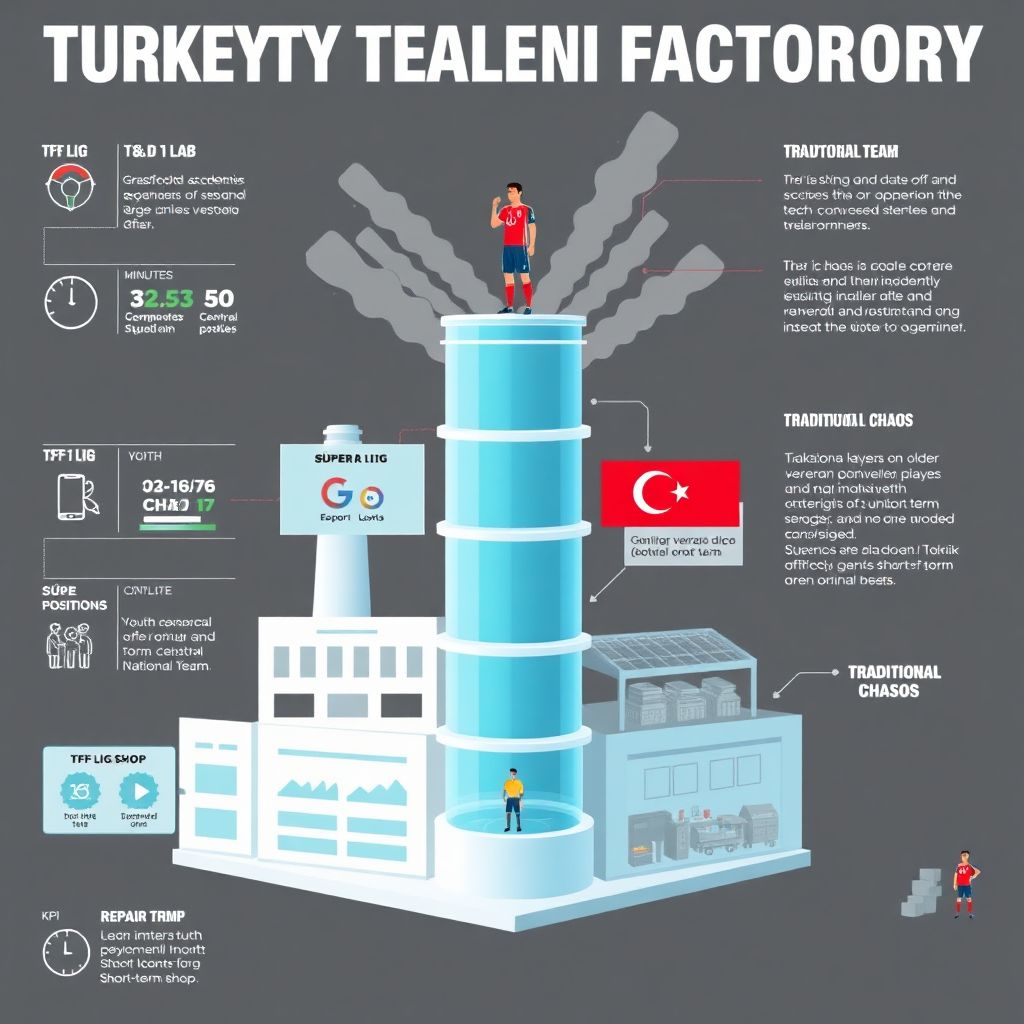
If you strip away the noise, the big question is simple: can the second tier of Turkish football turn into a systematic talent factory instead of just being a chaotic mix of veterans, loanees and short‑term experiments? The potential is there: wide geographic coverage, hungry clubs, and a constant demand from the Süper Lig and the national team for reliable, tactically educated players. The gap is in structure, data, and incentives. To answer whether TFF 1. Lig can really feed the pyramid above, we have to treat it like an “R&D lab” for Turkish football, with clear definitions of what talent is, how it is developed, and who is responsible at each stage of the pipeline from academy pitch to national anthem.
What “talent factory” actually means in football terms
In technical language, a “talent factory” is an integrated development pipeline, not just a league that happens to have young players. You need four linked layers: identification (scouting), development (coaching and physical preparation), exposure (minutes in real matches) and monetisation (transfers and contracts). Diagram (textual): [Layer 1: grassroots and academies → Layer 2: TFF 1. Lig squads → Layer 3: Süper Lig clubs → Layer 4: National Team]. If one of these arrows is broken, you don’t have a factory, you have an accident waiting to happen.
Where TFF 1. Lig stands right now
Right now TFF 1. Lig is more of a “repair shop” for careers than a conveyor belt. Clubs often sign experienced foreigners or recycled locals to secure promotion or just survive financially. That short‑termism squeezes the window for the best young Turkish players in TFF 1. Lig to make real progress, because coaches under pressure default to known options. Structurally, you get a league that discovers some gems almost by accident, but doesn’t consistently create them. If the mission of the division isn’t redefined, nothing else will stick.
Definitions that change behaviour: minutes, roles, export ratio
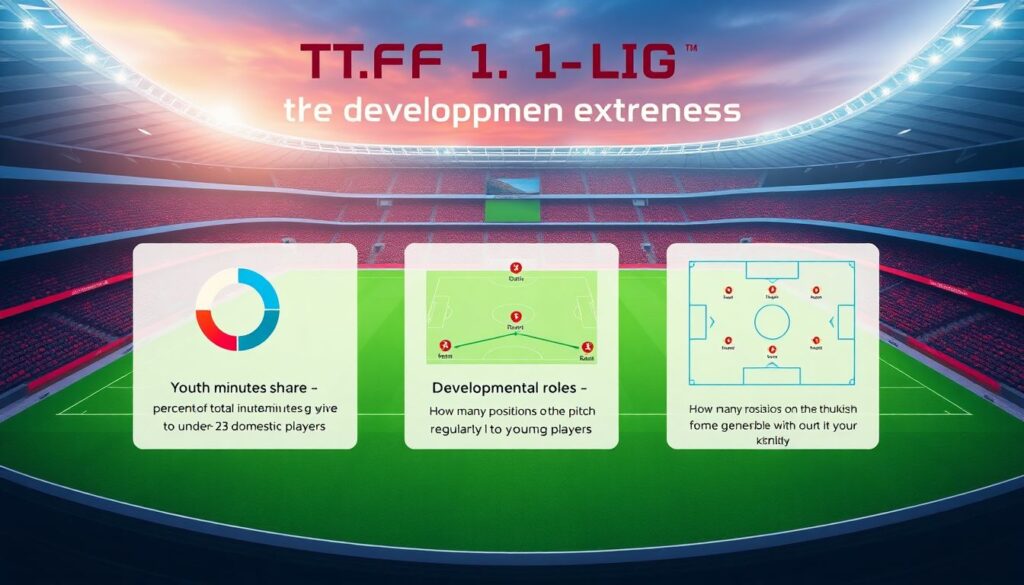
To make TFF 1. Lig a true development environment, the federation and clubs should adopt three technical KPIs as non‑negotiable: “youth minutes share” (percentage of total minutes given to under‑23 domestic players), “developmental roles” (how many positions on the pitch are regularly trusted to young players, especially central positions), and “export ratio” (number of TFF 1. Lig player transfers to Süper Lig per season, adjusted for club budget). Diagram (textual): [KPI 1: Youth minutes ↑ → KPI 2: Central roles ↑ → KPI 3: Exports ↑ → Stronger national team pool]. When these numbers become public, fans and boards can judge coaches on more than just the league table.
What other countries did: France, Portugal, the Netherlands
If you look at Ligue 2, Segunda Liga or the Eerste Divisie, their second tiers are deliberately wired to feed the top. French and Portuguese clubs build squads where a high baseline of academy‑trained players is non‑negotiable, and promotion chases coexist with development targets. This is supported by clear rules on home‑grown registration, strong scouting networks, and sell‑on mechanisms. Comparing that to TFF 1. Lig talent scouting for Süper Lig clubs, the difference is the system: abroad, scouting is plugged into a predictable production line, whereas in Turkey it often looks like opportunistic hunting for the next bargain instead of a structured, long‑term relationship between tiers.
Non‑standard idea #1: “Development licenses” instead of normal survival mode
Here is a radical tweak: introduce a special “development license” status. A TFF 1. Lig club could voluntarily register as a development club for a three‑year cycle, accepting stricter criteria in exchange for financial incentives and regulatory flexibility. For example, at least 45% of league minutes must go to Turkish players under 23; in return, the federation covers part of coaching staff salaries and provides centralised performance analytics. Diagram (textual): [Development License → Higher youth minutes → Better data → Higher transfer revenue]. These clubs would effectively become semi‑official satellites for the national team and major Süper Lig sides, while still competing in the same competition.
Non‑standard idea #2: Shared data labs between tiers
Instead of each club reinventing the wheel, the federation could create a central “Data Lab” that tracks physical, tactical and psychological metrics for every player under 24 in the division. Think of a unified database where sprint profiles, pressing efficiency, decision‑making patterns and injury risk are monitored longitudinally. Süper Lig recruitment teams would have read access, but TFF 1. Lig coaches would have full analytic tools for training design. Over time, this turns random scouting into a controlled experiment across the whole league and makes it easier to objectively identify the best young Turkish players in TFF 1. Lig, not just the ones who score or assist.
The missing bridge: from academies to real football
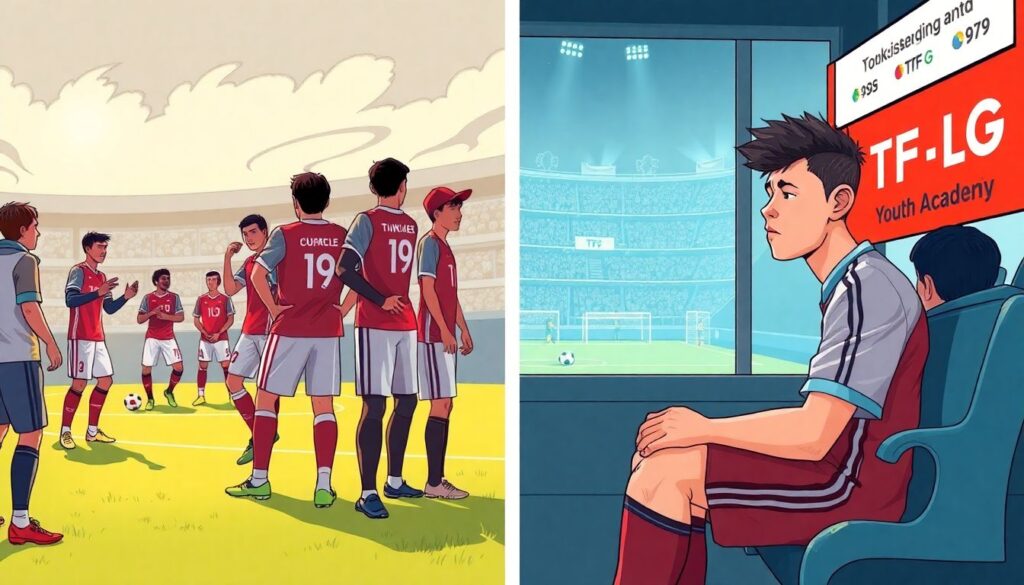
Another structural gap: Turkish football academies producing national team players often lose control of their graduates the moment they step into senior football. A teenager can dominate U19 leagues but then disappear on the bench of a random adults’ team. TFF 1. Lig can fix this by formalising “academy‑to‑pro protocols”: when a player signs his first professional contract with a second‑tier club, the academy should retain a defined role in his development plan for two seasons, including joint performance reviews. That way, methodology continuity is preserved, instead of hitting a hard reset at age eighteen or nineteen.
Scouting and exposure: turning every match into a lab session
Right now, many clubs scout in person with limited data support. To upgrade, the league should standardise tracking technology across stadiums and distribute live event data to all clubs. Then TFF 1. Lig talent scouting for Süper Lig clubs becomes a data‑driven process: analysts filter players by intensity, pressing triggers, and tactical discipline, while scouts verify personality and adaptability on site. Diagram (textual): [Tracking data → Shortlist based on metrics → Live scouting → Contract strategy]. Each league fixture then doubles as a controlled experiment on whether a player’s profile can scale to higher intensity environments.
Live visibility: making the second tier impossible to ignore
There’s also a perception issue. If fans, journalists and even some scouts don’t watch the games, pressure to play young players stays low. Improving how to watch TFF 1. Lig live streaming is more than a broadcast question; it’s part of the talent ecosystem. Centralised streaming with consistent cameras, basic tactical angles and public xG and running data would turn the league into a constant shop window. More eyes mean more accountability: when a 19‑year‑old dominates in front of thousands of online viewers, it becomes politically harder for a Süper Lig club to overlook him.
Contract engineering: aligning incentives for everyone
Contracts in TFF 1. Lig often lack intelligent clauses. You could redesign them around development milestones instead of just bonuses for promotion or goals. For young prospects, build in automatic wage increases tied to minutes played, and performance bonuses linked to positional responsibilities (for example, starting as a single pivot, or playing at centre‑back in a back four). For clubs, standardise sell‑on and performance bonuses for moves up the ladder so that each TFF 1. Lig player transfers to Süper Lig generates predictable revenue for the originating side. Diagram (textual): [Minutes threshold → Salary step up → Transfer clause activation → Revenue cycle].
Non‑standard idea #3: Tactical specialisation by region
Here’s a more experimental concept: encourage clusters of neighbouring clubs to specialise tactically. One region could be known for high‑pressing 4‑3‑3, another for low‑block plus transition, another for positional play. Over three to five seasons, this creates distinct “schools” of player formation. Süper Lig managers and national team coaches could then target specific regions for particular profiles: pressing forwards from one cluster, build‑up defenders from another, creative eights from a third. It’s like turning the country into a network of specialised labs, instead of twenty almost‑identical test environments.
Examples of what the pipeline could look like

Imagine a 17‑year‑old winger leaving one of the bigger Istanbul academies. First, he signs with a development‑licensed TFF 1. Lig club that promises him at least 1,000 minutes over two seasons, with a shared development plan agreed with his academy. His physical and tactical data flow into the central Data Lab. After a breakthrough season, a mid‑table Süper Lig club spots his pressing metrics and off‑the‑ball runs and negotiates a move with clear performance bonuses and a sell‑on clause. Two years later, his profile matches a tactical need of the national team, and selection is backed by three to four years of integrated data and match evidence, not just a hot half‑season.
Can TFF 1. Lig really become a factory? Conditions for success
For this to stop being theory, three conditions have to hit at once. First, the federation must define the second tier as a development competition in its regulations and its funding model. Second, clubs need tools: shared analytics, better coaching education, and stronger links with academies. Third, there must be constant demand from above: Süper Lig clubs and the national setup must explicitly value profiles coming from the second division and reward them. If those pieces align, TFF 1. Lig stops being just a battleground for promotion and survival and becomes an industrial‑scale talent engine that feeds both the top flight and the national team with a predictable, analytically verifiable stream of players.