
Why Turkey’s Streets Are Secret Training Grounds
In Turkey, the football journey usually starts with plastic bottles as goalposts and cracked asphalt instead of grass. Street football looks chaotic, but it secretly builds skills that many academies try to simulate: fast decision-making, tight ball control, and resilience. If you’re a young player, don’t underestimate these games under the apartment lights. Treat them as your “informal lab”, where you test tricks, learn to handle pressure from older kids, and figure out how to read opponents without a coach shouting instructions.
Hidden advantages of street games

Street football forces you to adapt to uneven ground, random teams and constant interruptions. That messy environment trains balance, creativity and mental toughness. You learn to protect the ball when space is tiny and fouls are frequent. This is exactly why many scouts say they instantly notice players who grew up playing outside rather than only in organized sessions. The key is to combine that free style with structured training instead of choosing one and rejecting the other.
Step 1: Building a Real Foundation at Home
Before chasing trials and contracts, most kids skip the boring but critical step: technical basics on their own. Ten minutes a day with a ball can easily beat two hours of distracted training twice a week. Set micro-goals: 100 wall passes with each foot, 50 juggles, 20 turns in a tight space. Record yourself with a phone and actually watch the clips. This self-analysis habit will later help you communicate with coaches and adjust your game faster than your teammates.
Smart solo training, not just more running
Running endless laps won’t turn you into a modern player. Focus instead on short, intense drills that copy match situations. For example, work on first touch while turning, shooting after a quick change of direction, or receiving passes with your weaker foot only. Use simple tools: two cones, a wall and a cheap resistance band are enough. The aim is to arrive at football academies in Turkey for young players already looking like someone who understands the ball, not just someone who likes to run.
Step 2: Choosing the Right Local Environment
The first organized step is usually a neighborhood club or municipal academy. Many families pick the one closest to home, but proximity is less important than coaching quality and training culture. Go watch a session before joining: are coaches explaining ideas clearly or just shouting? Are the kids actually touching the ball often, or just doing fitness drills? A good local setup prepares you for higher levels without burning you out with pressure and pointless tournaments every weekend.
Red flags most parents miss

Be wary of clubs that promise fast stardom, demand expensive gear immediately, or guarantee that “scouts will definitely see your child”. Over-focused parents on the sidelines can also poison the atmosphere. If training looks like a military drill with little joy or creativity, long-term development usually suffers. On the other hand, a club that loses some games but gives all players minutes, rotates positions and encourages risk-taking often produces more complete footballers a few years down the line.
Step 3: From Local Club to Serious Academy
Once a player stands out locally, the next target is a more structured youth academy program. Here, selection events and internal recommendations matter. Ask your current coach for an honest assessment: is your level ready for stronger opposition, or do you need another season to grow physically and tactically? The pathway is rarely linear; some kids benefit from staying one extra year in a smaller pond before jumping into deeper waters where competition for places is brutal.
How trials really work in Turkey
Many families wonder how to get a football trial in Turkey for young talents without falling into scams. Reputable clubs advertise open trials on their official sites or social media, not via random WhatsApp groups. Some academies invite players after seeing them in regional tournaments or via trusted coach recommendations. During these trials, scouts care less about tricks and more about decision-making: do you scan the field, support teammates, and recover quickly after losing the ball? That mindset separates trial tourists from real prospects.
Understanding Club Academies and Alternatives
Professional football clubs in Turkey with youth academies, such as the big Istanbul sides and several Anatolian teams, offer the most direct road to top-level football. Yet spots are limited, and not every child thrives in a highly competitive environment at 12 or 13. Independent academies, football schools and private trainers can sometimes offer a softer step, especially for late bloomers. Mixing these options strategically can actually be more effective than obsessing over a single “dream club”.
Costs, investments and hidden expenses
Parents often worry about the cost of football academy training in Turkey for kids, and with reason. Fees can vary widely, and official price lists rarely include travel, boots, medical checks and extra camps. Instead of blindly paying for the most expensive program, ask concrete questions: How many training hours per week? How many kids per coach? What percentage of graduates reach higher levels? Treat it like evaluating a school, not a status symbol; data matters more than fancy kits and glossy brochures.
Step 4: Camps, Tournaments and International Exposure
Holiday periods are a strategic window. The best youth soccer camps in Turkey for international students attract not only foreign kids but also local players seeking different coaching philosophies. Joining such camps can expose you to new styles, languages and tactical ideas in a compressed time frame. Instead of collecting camp certificates, choose one or two per year that actually challenge you, with plenty of game time, video feedback and mixed-age sessions where you must adapt quickly.
How to use camps creatively
Think of camps as laboratories, not vacations. Try new positions, experiment with your weaker foot, or even set a personal goal like “no long balls under pressure for three days”. After the camp, write a short report: what did I do well, what did coaches criticize, which drills felt hardest? This simple habit turns each camp into a data point for your progress. Over a few years, you’ll see clear patterns and know exactly which skills deserve extra focus at home.
Step 5: Education, Language and Life Balance
A common mistake in promising teenagers is treating school as a nuisance. Yet modern clubs care about discipline, communication and adaptability almost as much as raw talent. Learning English, for instance, opens access to tactical material online and makes it easier to work with foreign coaches. Reading about sports science, sleep and nutrition also gives you an edge. Players who understand why they train a certain way tend to avoid overtraining, injuries and illusions about “magical” shortcuts to success.
Burnout and mental health
Training six days a week while carrying school stress and family expectations can quietly drain motivation. Warning signs include constant fatigue, irritability and a sudden drop in joy when playing. Building one non-football hobby—a musical instrument, drawing, or simple reading—can act as a psychological safety valve. This doesn’t distract from your dream; it preserves it. Clubs increasingly look for mentally stable players who can handle pressure, social media noise and competition without collapsing at the first setback.
Unconventional Strategies That Actually Work
Beyond standard training, some less obvious moves can drastically raise your ceiling. Street matches in different neighborhoods expose you to new styles and physicality. Playing futsal once a week forces you to think quicker and refine your first touch. Even pickup games with older, stronger players in a local gym can build toughness. These “side quests” expand your football brain faster than repeating the same drills with the same teammates three times a week on the same artificial pitch.
DIY scouting and self-promotion without being annoying
Instead of waiting passively for scouts, build a small digital portfolio. Film full matches, not only highlight reels, and upload them with basic information in English and Turkish. A short, honest email to targeted coaches or academies with these links can be more effective than paying middlemen. Just avoid spamming every club on earth. Quality over quantity: adapt your message, mention why their program fits your style and what you hope to improve rather than bragging about past trophies.
Common Mistakes on the Path to the Professional Pitch
Several recurring errors derail promising journeys. Over-focusing on individual stats instead of team impact is one. Chasing early specialization—like forcing a 10-year-old to be only a winger—often backfires when body type or tactics change. Ignoring nutrition and sleep seems minor at first but catches up around growth spurts. And perhaps the biggest trap in Turkey is believing that a single famous coach or club badge guarantees a contract, instead of viewing development as a long, adaptive process.
Checklist: Smarter way through the system
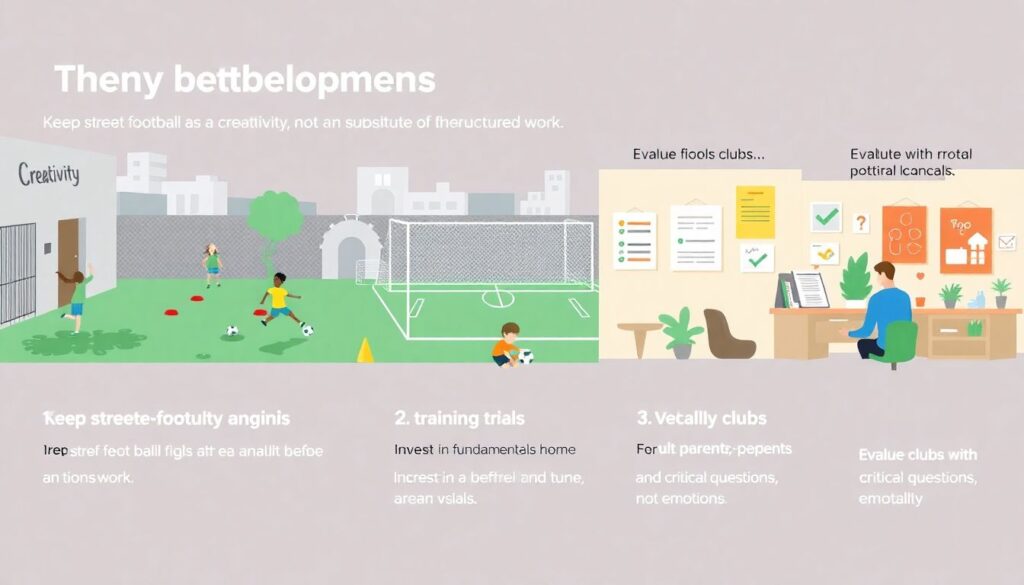
1) Keep street football as a creativity engine, not a substitute for structured work. 2) Invest in fundamentals at home before hunting trials. 3) Evaluate clubs with critical questions, not emotions. 4) Use camps and tournaments as experiments, documenting what you learn. 5) Treat education, languages and mental health as part of your training plan. Players who combine these elements steadily increase their chances, whether they end up in a top club or carve out a professional career in smaller leagues.